Introduction
Cryptocurrency prices can change quickly. Bitcoin may rise or fall within a short period, while smaller digital assets can experience even sharper price movements. Because of these changes, crypto investors often hear two terms: volatility and risk.
Many beginners use these terms interchangeably. However, they do not mean exactly the same thing.
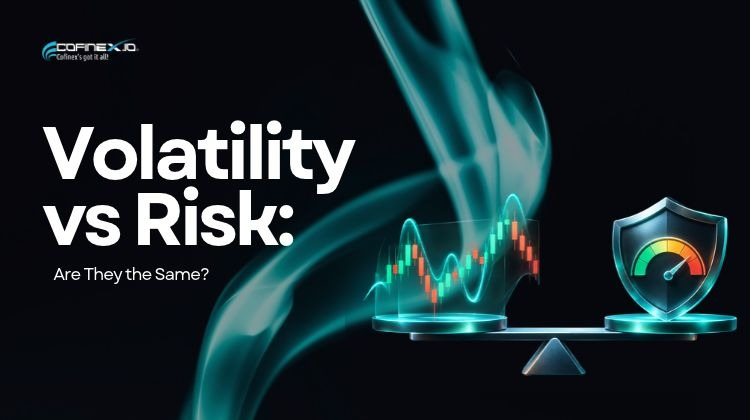
Volatility describes how much an asset’s price changes over time. Risk, on the other hand, refers to the possibility of experiencing a loss or an unwanted financial outcome.
Understanding this difference is important because a highly volatile asset is not automatically the riskiest investment. Similarly, an asset with relatively stable prices can still carry significant risks.
In this lesson, we will explain what volatility and risk mean, how they differ, and why both matter when making crypto investment decisions.
What is Volatility in Crypto?
Volatility refers to the degree and speed at which an asset’s price moves over a particular period.
In simple terms, it tells you how much the price fluctuates.
For example, imagine two cryptocurrencies:
- Crypto A: Its price moves between ₹100 and ₹105 over a period.
- Crypto B: Its price moves between ₹100 and ₹140 over the same period.
In this simplified example, Crypto B shows greater price movement. Therefore, it is more volatile than Crypto A.
However, volatility can work in both directions. An asset may experience sharp price increases as well as sudden declines.
What Causes Crypto Volatility?
Several factors can influence cryptocurrency price movements.
1. Market Demand and Supply
When buying demand increases, prices may rise. Conversely, when more people want to sell, prices may come under pressure.
2. News and Market Events
Regulatory announcements, exchange developments, security incidents, and major economic events can influence market sentiment. As a result, prices may move quickly.
3. Market Liquidity
Liquidity refers to how easily an asset can be bought or sold without significantly affecting its price. When liquidity is low, even relatively small orders may cause larger price movements.
4. Investor Sentiment
Fear, uncertainty, excitement, and speculation can influence buying and selling decisions. Consequently, sudden changes in sentiment may increase price fluctuations.
What is Risk in Crypto?
Risk refers to the possibility that an investment may result in a loss or an outcome that does not match your expectations.
In crypto, risk is not limited to price changes. Investors may also face security problems, technical failures, liquidity issues, and regulatory uncertainty.
For example, imagine buying a cryptocurrency at ₹100. Its price remains relatively stable for several weeks. However, the project later experiences a serious security incident that affects its operations.
Even though the asset did not show extreme price volatility beforehand, your investment still faced significant risk.
Common Types of Crypto Risk
1. Market Risk
Market risk is the possibility of losing money because of changes in cryptocurrency prices. For example, Bitcoin’s price may fall during a broader market decline.
2. Liquidity Risk
Liquidity risk occurs when you cannot buy or sell an asset easily at a reasonable price. This problem can become more serious when market activity is low.
3. Security Risk
Crypto wallets, exchanges, and smart contracts can face hacking attempts, vulnerabilities, and other security threats. Therefore, poor security practices can put digital assets at risk.
4. Regulatory Risk
Changes in laws, government policies, or regulatory requirements may affect how certain crypto activities operate. As a result, projects and investors may face uncertainty.
5. Project Risk
A crypto project may fail to deliver its promises, lose users, experience technical problems, or stop operating. Consequently, its token may lose value or become difficult to trade.
Volatility vs Risk: What is the Difference?
Although volatility and risk are connected, they measure different things.
| Feature | Volatility | Risk |
|---|---|---|
| Meaning | Degree of price fluctuation | Possibility of loss or an unwanted outcome |
| Main focus | Price movement | Potential negative outcomes |
| Measurement | Often measured using historical price changes or standard deviation | Depends on the type of risk being assessed |
| Direction | Includes both upward and downward movements | Focuses on potential adverse outcomes |
| Example | Bitcoin experiences large daily price movements | An investor loses money after a market decline |
In simple terms, volatility tells you how much an asset’s price moves, while risk helps you understand what could go wrong with an investment.
Can an asset have high volatility but different levels of risk?
Yes. Volatility and risk do not always move together.
Let’s understand this through two examples.
Example 1: A Highly Volatile Asset
Imagine a cryptocurrency whose price changes sharply every day. It rises by 15% one day and falls by 12% the next.
This asset has high volatility because its price fluctuates significantly.
However, price volatility alone does not tell you everything about the project’s security, financial structure, liquidity, or long-term prospects. Those factors also matter when assessing its overall risk.
Example 2: A Stable-Looking Asset
Now imagine a token whose price remains close to ₹100 for several months.
At first, it may appear less risky because its price does not change much. However, suppose the token has weak liquidity, limited transparency, and an unclear mechanism supporting its value.
In that situation, the asset may carry significant risks despite its relatively stable price.
Therefore, never judge an investment only by how frequently its price changes.
Why do crypto investors need to understand both?
Understanding volatility and risk helps investors make more informed decisions.
1. It Helps Set Realistic Expectations
If you understand volatility, you are less likely to be surprised by sudden price movements. Moreover, understanding risk helps you consider the possibility of losing money before investing.
2. It Supports Better Risk Management
Investors can use position sizing, diversification, and other risk-management practices to manage their exposure.
For example, investing a smaller portion of your available capital in a highly uncertain asset may help limit the impact of a potential loss. However, no strategy can eliminate investment risk completely.
3. It Reduces Emotional Decisions
Sharp price movements can create fear or excitement. As a result, beginners may buy because prices are rising or sell because prices are falling.
By understanding the difference between volatility and risk, investors can focus on their research and investment plan rather than reacting to every market movement.
4. It Encourages Better Research
Volatility tells you about price behaviour. However, assessing risk requires a wider review.
You may need to examine a project’s technology, security, token supply, liquidity, team transparency, and other relevant factors.
How can you manage volatility and risk?
Although you cannot control the crypto market, you can take steps to manage your exposure.
- Diversify your investments: Avoid putting all your available capital into a single cryptocurrency.
- Understand the asset: Research the project’s purpose, technology, tokenomics, and risks before investing.
- Set a budget: Invest only money you can afford to lose.
- Avoid emotional decisions: Do not buy or sell simply because of sudden market movements.
- Use position sizing: Decide how much capital you are willing to expose to a particular investment.
- Review your portfolio: Check whether your investments still match your financial goals and risk tolerance.
In addition, remember that diversification and research can reduce certain risks, but they cannot guarantee profits or prevent losses.
Common Mistakes to Avoid
Beginners often make these mistakes when evaluating crypto investments:
- Assuming low volatility means an asset is completely safe.
- Treating every price decline as proof that a project has failed.
- Ignoring security and liquidity risks.
- Investing based only on recent price performance.
- Taking larger positions because an asset appears stable.
- Believing that diversification removes all investment risk.
Instead, consider both price behaviour and the wider factors that may affect an investment.
Frequently Asked Questions (FAQs)
1. Is volatility the same as risk?
No. Volatility measures the extent of price fluctuations, while risk refers to the possibility of loss or an unwanted financial outcome.
2. Does high volatility mean high risk?
Not necessarily. High volatility indicates larger price movements, but overall investment risk also depends on factors such as liquidity, security, and project reliability.
3. Can a cryptocurrency have low volatility but high risk?
Yes. A cryptocurrency may show relatively stable prices while still having security vulnerabilities, weak liquidity, or an unreliable project structure.
4. How is crypto volatility measured?
Volatility is commonly estimated using historical price movements and statistical measures such as standard deviation. Some platforms also provide volatility indicators based on different time periods.
5. Can investors avoid crypto volatility?
No. Investors cannot completely avoid market volatility when holding cryptocurrencies. However, they can manage their exposure through research, diversification, position sizing, and a clear investment plan.
Disclaimer: This article is for educational purposes only and does not provide financial or investment advice. Cryptocurrency investments involve significant risks, including the possibility of losing your entire investment. Always conduct your own research before making financial decisions.