What is Circulating Supply?
Circulating supply refers to the number of coins or tokens currently available in the market and generally accessible to the public.
These tokens may be held by individual investors, traders, exchanges, or other market participants.
For example, imagine a cryptocurrency has:
- 100 million tokens created.
- 60 million tokens available in the market.
- 40 million tokens locked or reserved.
In this example, its circulating supply is 60 million tokens.
Why does this matter?
Circulating supply helps calculate a cryptocurrency’s market capitalisation.
The formula is:

Its market capitalisation would be ₹60 crore.
However, circulating supply does not tell you the complete story. You should also check how many tokens are locked, reserved, or scheduled for release.
What is Total Supply?
Total supply refers to the total number of coins or tokens that have been created, minus any tokens that have been permanently burned.
It generally includes tokens that are currently circulating as well as tokens that are locked, reserved, or held for future distribution.
Let’s continue with the previous example:
- Circulating supply: 60 million tokens.
- Locked tokens: 40 million tokens.
- Total supply: 100 million tokens.
This means the project has created 100 million tokens, but only 60 million are currently circulating.
Why is total supply important?
It helps investors understand how many tokens already exist, including those that may enter circulation later.
For example, if a project plans to unlock a large number of tokens in the future, the additional supply could affect market dynamics.
Important: Total supply does not always mean that every token is available for trading. Some tokens may remain locked or restricted.
What is Maximum Supply?
Maximum supply refers to the highest number of coins or tokens that can ever exist under a cryptocurrency’s current protocol or token rules.
In simple terms, it represents the supply limit.
For example, Bitcoin has a maximum supply of 21 million BTC. Its protocol sets this limit, and new bitcoins enter circulation through mining rewards.
However, not every cryptocurrency has a fixed maximum supply.
Some projects have:
- A fixed maximum supply.
- No predefined maximum supply.
- Supply rules that allow additional tokens to be created through governance or protocol changes.
Therefore, always check a project’s tokenomics to understand whether its maximum supply is fixed or can change.
Circulating Supply vs Total Supply vs Max Supply
Now that we understand each term, let’s compare them.
| Feature | Circulating Supply | Total Supply | Maximum Supply |
|---|---|---|---|
| Meaning | Tokens currently circulating in the market | Tokens created minus permanently burned tokens | Highest possible supply under current rules |
| Includes locked tokens? | Generally no | Yes, if already created | Represents the supply limit |
| Changes over time? | Yes | Yes, if new tokens are created or burned | Usually fixed, but depends on protocol rules |
| Main purpose | Helps calculate market capitalisation | Shows existing token supply | Shows potential supply limit |
In simple terms:
- Circulating supply tells you how many tokens are currently in circulation.
- Total supply tells you how many tokens exist after accounting for burns.
- Maximum supply tells you how many tokens can exist at most under the current rules.
Practical Example: Understanding All Three Together
Imagine a fictional cryptocurrency called ABC Token.
Its tokenomics look like this:
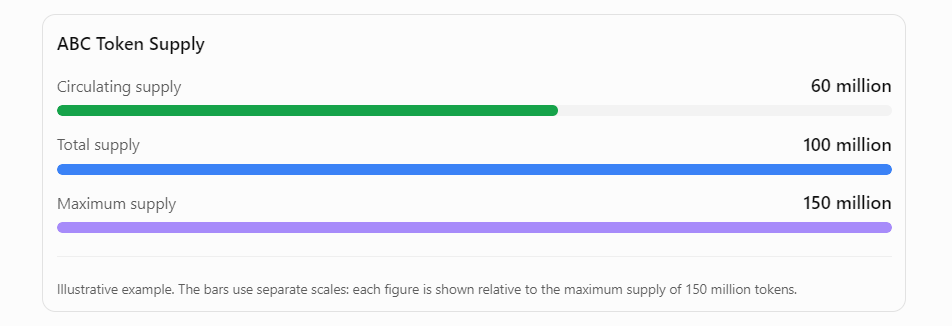
Here’s what these numbers tell us:
- 60 million tokens are currently circulating.
- 40 million tokens exist but are not currently circulating.
- Another 50 million tokens could potentially be created in the future.
This means the project has a maximum supply of 150 million tokens, but only 60 million are currently circulating.
As more tokens enter circulation, the circulating supply may increase. However, the actual impact on price depends on demand, liquidity, token distribution, and other market conditions.
Why Do These Supply Metrics Matter to Crypto Investors?
Understanding token supply is important because it helps you look beyond the current token price.
Here are four reasons why these metrics matter.
1. Understanding Market Capitalisation
Market capitalisation uses circulating supply, not maximum supply.
Therefore, two cryptocurrencies with the same token price can have very different market capitalisations if their circulating supplies differ.
2. Identifying Future Token Unlocks
Some projects release tokens gradually to teams, investors, or ecosystem funds.
When locked tokens enter circulation, the available supply increases. If demand does not grow at a similar pace, this additional supply may create selling pressure.
However, an unlock does not automatically mean that the token price will fall.
3. Understanding Fully Diluted Valuation (FDV)
Fully Diluted Valuation estimates the value of a cryptocurrency if its maximum supply were circulating, using the current token price.
The formula is:

Its FDV would be ₹150 crore.
FDV helps investors compare the current market capitalisation with the potential valuation based on maximum supply.
However, FDV is an estimate, not a prediction of future market value.
4. Evaluating Tokenomics
Token supply is an important part of tokenomics.
Before evaluating a cryptocurrency, check:
- How many tokens are currently circulating?
- How many tokens already exist?
- Is there a maximum supply?
- Are tokens locked for future release?
- Can the project create additional tokens?
- Are tokens regularly burned?
These questions can help you understand how a project’s supply may change over time.
Common Mistakes to Avoid
Beginners often misunderstand token supply metrics. Watch out for these mistakes:
1. Assuming total supply and maximum supply are the same
They are different. Total supply represents existing tokens after burns, while maximum supply represents the upper limit under current rules.
2. Looking only at circulating supply
A low circulating supply may make a token’s market capitalisation appear small. However, a large amount of locked supply could enter circulation later.
3. Assuming maximum supply is always fixed
Some cryptocurrencies have no fixed maximum supply. Others may allow changes through governance or protocol upgrades.
4. Assuming token burns always increase prices
Burning tokens reduces supply, but it does not guarantee a price increase. Demand and broader market conditions also matter.
Frequently Asked Questions (FAQs)
1. Which is more important: circulating supply or total supply?
Both are important. Circulating supply helps calculate market capitalisation, while total supply shows how many tokens already exist, including locked tokens.
2. Can circulating supply increase over time?
Yes. Circulating supply can increase when locked or reserved tokens become available for distribution. It can also decrease if tokens are permanently burned or otherwise removed from circulation.
3. Is maximum supply always fixed?
No. Some cryptocurrencies have a fixed maximum supply, while others have no predefined limit or allow changes through protocol rules and governance.
4. What happens when circulating supply reaches maximum supply?
If all tokens under a fixed maximum supply enter circulation and no additional tokens can be created, circulating supply may equal maximum supply. However, permanently burned tokens or other supply rules can affect the figures.
5. Does a higher circulating supply mean a cryptocurrency is less valuable?
No. A higher circulating supply does not automatically make a cryptocurrency less valuable. Token price also depends on demand, utility, adoption, liquidity, and market conditions.
Disclaimer: This article is for educational purposes only and does not constitute financial or investment advice. Cryptocurrency investments involve risk. Always research a project’s tokenomics and supply distribution before making investment decisions.