What are Crypto Network Fees?
A network fee is the amount users pay to process a transaction on a blockchain.
Whenever you send cryptocurrency, interact with a smart contract, or perform certain blockchain activities, the network needs to process and validate your transaction.
Network fees help compensate the participants who provide the resources needed to operate the blockchain.
For example:
- Bitcoin users pay transaction fees to miners.
- Ethereum users pay gas fees for transactions and smart contract operations.
- Other blockchain networks use their own fee structures and validation mechanisms.
These fees are generally paid in the blockchain’s native cryptocurrency.
Remember: A network fee is different from an exchange trading fee. A network fee goes towards processing a blockchain transaction, while an exchange fee is charged by a trading platform for providing its services.
Why do Network Fees change?
Network fees can change for several reasons. Let’s understand the most important ones.
1. Network Congestion
One of the biggest reasons for changing network fees is congestion.
Think of a blockchain as a road. When fewer vehicles are on the road, traffic moves smoothly. However, when too many vehicles enter at the same time, congestion increases.
Blockchain networks work in a similar way.
When many users send transactions simultaneously, the network receives more requests than it can process immediately.
As a result, users may compete to get their transactions included sooner by offering higher fees.
For example, during a period of heavy activity, Bitcoin users may pay higher transaction fees to encourage miners to prioritise their transactions.
2. Demand for Block Space
Block space refers to the limited amount of transaction data that a blockchain can include in each block.
Each blockchain has its own block-size or block-resource limits. Therefore, it cannot process an unlimited number of transactions in a single block.
When demand for block space increases, users may compete to have their transactions processed.
Consequently, fees can rise.
On the other hand, when fewer people are using the network, competition for block space may decrease, resulting in lower fees.
3. Transaction Size and Complexity
Not every blockchain transaction requires the same amount of resources.
For example, on Bitcoin, a transaction’s fee depends largely on its size in virtual bytes (vB), rather than simply the amount of BTC being transferred.
A transaction involving multiple inputs or outputs may require more block space than a simpler transaction.
Similarly, on Ethereum, different activities consume different amounts of gas.
For example:
- A basic ETH transfer generally requires less gas.
- A token transfer may require more gas.
- A complex smart contract interaction may require significantly more gas.
Therefore, the more resources a transaction requires, the higher its potential network fee.
4. Blockchain Fee Mechanisms
Different blockchains calculate transaction fees differently.
Let’s look at two popular examples.
Bitcoin transaction fees
Bitcoin users generally choose a fee rate measured in satoshis per virtual byte (sat/vB).
When the network becomes busy, users may offer higher fee rates to improve their chances of getting included in an earlier block.
Ethereum gas fees
Ethereum uses gas to measure the computational work required to process transactions.
Its fee mechanism includes:
- Base fee: The minimum fee per unit of gas required for a transaction to be included in a block.
- Priority fee: An additional amount users can offer to encourage validators to include their transactions.
- Gas used: The amount of computational resources the transaction consumes.
The total transaction fee is generally calculated as:

Ethereum’s base fee changes according to block usage. When blocks are more heavily used, the base fee can increase. When activity falls, it can decrease.
5. Market Activity and Special Events
Network fees can also increase during periods of unusual blockchain activity.
For example:
- A popular token launch.
- High NFT trading activity.
- Increased DeFi transactions.
- Heavy demand for token transfers.
- A sudden increase in cryptocurrency market activity.
During these periods, more users may interact with the same blockchain.
As a result, transaction demand can increase, and users may pay higher fees to get their transactions processed sooner.
However, market prices and network fees are not directly connected. A rising cryptocurrency price does not automatically mean higher network fees.
Why are Network Fees different across Blockchains?
Every blockchain has its own design, transaction capacity, and fee calculation method.
Therefore, transferring the same approximate value of cryptocurrency across two different networks does not necessarily cost the same.
| Blockchain | Fee mechanism | What can affect fees? |
|---|---|---|
| Bitcoin | Transaction fee rate (sat/vB) | Transaction size and demand for block space |
| Ethereum | Gas fee | Gas used, base fee, and priority fee |
| Solana | Transaction fees based on network rules | Base fees, priority fees, and network conditions |
| Polygon PoS | Gas-based transaction fees | Gas usage and network demand |
The actual fee can vary depending on the transaction, network conditions, and the platform used to initiate it.
Practical Example: How Network Congestion Changes Fees
Imagine you want to transfer cryptocurrency from one wallet to another.
On Monday, the blockchain has relatively low activity. Your transaction can enter the network without much competition.
However, on Tuesday, thousands of users start making transactions at the same time.
Now, more users are competing for limited block space. Some may offer higher fees to get their transactions processed sooner.
As a result, the fee you see on Tuesday may be higher than the fee you saw on Monday.
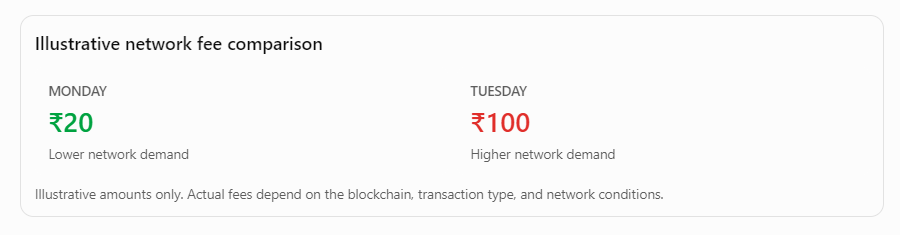
The transaction amount may be exactly the same on both days. However, the network fee can differ because the demand for processing transactions has changed.
How can you reduce Network Fees?
You cannot control blockchain network activity, but you can make informed decisions to manage transaction costs.
1. Check Network Conditions Before Transferring
Before sending cryptocurrency, check the estimated network fee. Some blockchain explorers and wallet applications provide information about current transaction costs.
2. Avoid Peak Congestion When Possible
If your transaction is not urgent, consider waiting for a quieter period when network demand may be lower.
However, fees can change quickly, so there is no guaranteed low-fee time.
3. Choose the Correct Network
Some cryptocurrencies are available on multiple blockchain networks.
Before transferring, check which networks the receiving wallet supports. Using an unsupported network can result in lost or inaccessible funds.
4. Understand Transaction Complexity
Smart contract interactions and other complex blockchain activities may require more resources than a basic transfer.
Check the estimated fee before confirming the transaction.
5. Review the Fee Before Confirming
Always check the final transaction details, including the network and estimated fee, before approving a transfer.
Common Mistakes to Avoid
- Assuming network fees remain the same throughout the day.
- Confusing exchange trading fees with blockchain network fees.
- Believing that sending a smaller amount always means paying a lower network fee.
- Choosing a different network without checking whether the receiving wallet supports it.
- Assuming that a higher fee guarantees instant confirmation.
- Ignoring the transaction fee before confirming a transfer.
Remember, a low transaction fee is useful only when you are using the correct network and the transaction meets your requirements.
Frequently Asked Questions (FAQs)
1. Why do crypto network fees increase?
Network fees may increase when more users compete to have their transactions processed. Limited block space and higher transaction demand can push fees upward.
2. Are crypto network fees fixed?
No. Many blockchain networks have variable fees that change according to network activity, transaction requirements, and their fee mechanisms.
3. Why are Ethereum gas fees sometimes expensive?
Ethereum gas fees can increase when demand for block space rises. Complex transactions also consume more gas, which can increase the total fee.
4. Does sending more cryptocurrency mean paying a higher network fee?
Not necessarily. On Bitcoin, fees mainly depend on transaction size and fee rate, rather than the amount of BTC transferred. On Ethereum, fees depend on gas used and the effective gas price.
5. Can I avoid paying network fees?
Most blockchain transactions require network fees. However, you may be able to reduce costs by choosing an appropriate network, checking fees before transferring, and avoiding periods of high congestion when possible.
Disclaimer: This article is for educational purposes only and does not constitute financial or investment advice. Network fees vary depending on blockchain conditions and transaction requirements. Always verify the network and fee before confirming a transaction.
Leave a Reply