Tag: Network Congestion

  • What is the Bitcoin mempool and why do transaction fees change?

    What is the Bitcoin mempool and why do transaction fees change?

    Have you ever sent Bitcoin and noticed that your transaction took longer than expected to confirm? Or perhaps you paid a higher transaction fee during a busy period.

    These situations often happen because of the Bitcoin mempool.

    The mempool plays an important role in how Bitcoin transactions move from one wallet to the blockchain. It also helps explain why transaction fees can increase or decrease depending on network activity.

    But what exactly is the Bitcoin mempool? How does it work, and why do some transactions confirm faster than others?

    Let’s understand it step by step.

    What is the Bitcoin mempool?

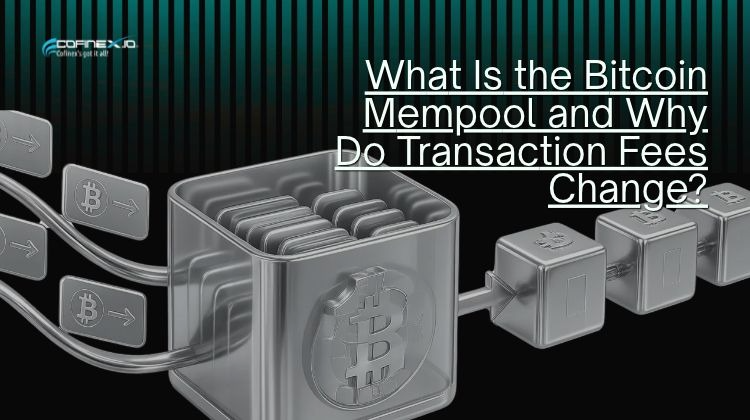
    The Bitcoin mempool, short for memory pool, is a temporary holding area for unconfirmed Bitcoin transactions.

    When someone sends Bitcoin, the transaction does not immediately become part of the blockchain. Instead, it first reaches Bitcoin nodes, which check whether it follows the network’s rules.

    If a node accepts the transaction, it may keep it in its mempool while waiting for a miner to include it in a block.

    In simple terms, think of the mempool as a waiting queue for Bitcoin transactions.

    However, there is an important detail: Bitcoin does not have one central mempool. Each node maintains its own collection of unconfirmed transactions. Therefore, different nodes may have slightly different mempools.

    How does the Bitcoin mempool work?

    The mempool helps organise transactions before miners add them to the blockchain.

    Here is how the process works:

    1. A user sends Bitcoin

    First, a user creates a Bitcoin transaction through a wallet. The transaction includes details such as the sender’s inputs, the recipient’s address and the amount being transferred.

    The wallet also calculates a transaction fee.

    2. The transaction reaches Bitcoin nodes

    Next, the wallet broadcasts the transaction to the Bitcoin network.

    Nodes check whether the transaction follows the network’s rules. For example, they verify the transaction’s signatures and check that it does not attempt to spend the same Bitcoin twice.

    If a node accepts the transaction, it may add it to its mempool and share it with other nodes.

    3. The transaction waits in the mempool

    After entering the mempool, the transaction waits for a miner to select it.

    However, transactions do not all receive equal priority. Miners generally consider the fee rate a transaction offers when selecting transactions for a block.

    As a result, transactions with more competitive fee rates may receive attention sooner.

    4. A miner includes the transaction in a block

    Once a miner selects the transaction and successfully mines a valid block, the transaction becomes part of the blockchain.

    At this point, it receives its first confirmation.

    5. More blocks add confirmations

    As miners add more blocks after the transaction’s block, the transaction receives additional confirmations.

    Generally, more confirmations provide stronger assurance that the transaction will remain part of the blockchain.

    Why do Bitcoin transaction fees change?

    Bitcoin transaction fees do not follow a fixed price.

    Instead, users compete for limited space in each block. When many people want to send Bitcoin at the same time, they may offer higher fees to encourage miners to select their transactions.

    Consequently, fees can rise during periods of heavy network activity.

    Let’s look at the main factors that influence them.

    1. Network congestion

    Network congestion occurs when many transactions compete for space in the mempool.

    For example, imagine that a large number of users send Bitcoin during the same period. If miners cannot confirm all those transactions immediately, the mempool may grow.

    As a result, users may offer higher fee rates to improve their chances of getting included in an upcoming block.

    On the other hand, when fewer transactions compete for space, users may be able to pay lower fees.

    2. Transaction size

    Bitcoin fees depend largely on transaction size, measured in virtual bytes (vB), rather than simply the amount of Bitcoin being transferred.

    For example, sending 0.01 BTC does not automatically cost less than sending 1 BTC.

    A transaction with more inputs or a more complex structure may require more block space. Therefore, it can cost more even when the transferred amount is smaller.

    3. Fee rate

    Bitcoin users generally express transaction fees as satoshis per virtual byte, written as sat/vB.

    A satoshi is the smallest unit of Bitcoin.

    One Bitcoin equals 100 million satoshis.

    For example, consider two transactions with the same virtual size:

    • Transaction A offers 5 sat/vB.
    • Transaction B offers 20 sat/vB.

    Transaction B offers a higher fee rate. Therefore, miners may prefer it when choosing transactions for a block.

    However, a higher fee rate does not guarantee immediate confirmation.

    4. Miner selection

    Miners choose transactions from their own mempools when building blocks.

    Since each block has limited capacity, miners generally prioritise transactions that offer higher fees relative to the block space they use.

    Therefore, users who offer competitive fee rates may improve their chances of faster confirmation.

    However, miners can also consider other factors, and different miners may select different transactions.

    5. Sudden increases in network activity

    Certain events can increase Bitcoin network activity.

    For instance, a rise in market activity, popular blockchain applications or a large number of transactions can increase competition for block space.

    Consequently, the mempool may grow and fee rates may change quickly.

    What happens when the Bitcoin mempool becomes full?

    The Bitcoin mempool does not have one universal capacity limit across the entire network. Each node manages its own mempool according to its settings and available resources.

    However, when a node reaches its configured mempool limit, it may remove lower-fee transactions to make room for new ones.

    This can affect transactions that offer less competitive fee rates.

    For example, a transaction may remain unconfirmed for a longer period. In some situations, it may disappear from a particular node’s mempool without ever entering a block.

    Importantly, this does not automatically mean that the Bitcoin has disappeared. The sender may need to wait, rebroadcast the transaction or use an appropriate replacement method, depending on the transaction and wallet.

    How can you check the Bitcoin mempool?

    You do not need advanced technical knowledge to understand current Bitcoin network activity.

    Several blockchain explorers and mempool tools provide information about unconfirmed transactions and estimated fee rates.

    For example:

    • Mempool.space: Displays the Bitcoin mempool, fee estimates and block activity.
    • Blockchain.com Explorer: Allows users to explore Bitcoin transactions and blocks.
    • Blockstream Explorer: Provides information about Bitcoin transactions, addresses and blocks.

    These tools can help you understand whether the network has many pending transactions and what fee rates users are currently offering.

    However, fee estimates are not guarantees. Actual confirmation times depend on network conditions and miner selection.

    How can you avoid paying unnecessarily high Bitcoin fees?

    You cannot control overall network demand, but you can make informed decisions when sending Bitcoin.

    Here are some useful practices:

    1. Check network activity: Before sending Bitcoin, review current mempool conditions and fee estimates.
    2. Choose an appropriate fee rate: If your transaction is not urgent, you may consider a lower fee rate when network activity allows it.
    3. Avoid unnecessary transactions: Combining payments where practical can help reduce the number of separate transactions.
    4. Use wallet fee recommendations carefully: Wallets often provide fee estimates, but you should understand the options before selecting one.
    5. Understand transaction urgency: A time-sensitive payment may require a more competitive fee than a transaction that can wait.

    Most importantly, do not assume that paying the highest suggested fee is always necessary.

    Frequently asked questions (FAQs)

    1. What happens when a Bitcoin transaction enters the mempool?

    When a transaction enters a node’s mempool, it waits for a miner to select it and include it in a block. Once the network confirms that block, the transaction becomes part of the blockchain.

    2. Does the Bitcoin mempool have a fixed size?

    No. Different nodes can configure their mempool limits differently. Therefore, there is no single universal mempool size for the entire Bitcoin network.

    3. Why are Bitcoin transaction fees sometimes high?

    Fees can rise when many transactions compete for limited block space. During busy periods, users may offer higher fee rates to improve their chances of faster confirmation.

    4. Can a Bitcoin transaction remain unconfirmed?

    Yes. A transaction may remain unconfirmed when miners have not selected it for a block. Its waiting time can depend on its fee rate and current network activity.

    5. Does sending a larger amount of Bitcoin mean paying a higher fee?

    Not necessarily. Bitcoin transaction fees depend mainly on the transaction’s virtual size and fee rate, rather than the amount of Bitcoin transferred.

    6. Can I track my Bitcoin transaction?

    Yes. You can use a Bitcoin blockchain explorer to search for your transaction ID (TXID) and check its status, fee and confirmation details.

    Disclaimer: This article is for educational purposes only and does not provide financial or investment advice. Bitcoin transaction fees and confirmation times can change depending on network conditions. Always review transaction details before confirming a payment.
  • Why Do Crypto Network Fees Change? A Beginner’s Guide

    Why Do Crypto Network Fees Change? A Beginner’s Guide

    What are Crypto Network Fees?

    A network fee is the amount users pay to process a transaction on a blockchain.

    Whenever you send cryptocurrency, interact with a smart contract, or perform certain blockchain activities, the network needs to process and validate your transaction.

    Network fees help compensate the participants who provide the resources needed to operate the blockchain.

    For example:

    • Bitcoin users pay transaction fees to miners.
    • Ethereum users pay gas fees for transactions and smart contract operations.
    • Other blockchain networks use their own fee structures and validation mechanisms.

    These fees are generally paid in the blockchain’s native cryptocurrency.

    Remember: A network fee is different from an exchange trading fee. A network fee goes towards processing a blockchain transaction, while an exchange fee is charged by a trading platform for providing its services.

    Why do Network Fees change?

    Network fees can change for several reasons. Let’s understand the most important ones.

    1. Network Congestion

    One of the biggest reasons for changing network fees is congestion.

    Think of a blockchain as a road. When fewer vehicles are on the road, traffic moves smoothly. However, when too many vehicles enter at the same time, congestion increases.

    Blockchain networks work in a similar way.

    When many users send transactions simultaneously, the network receives more requests than it can process immediately.

    As a result, users may compete to get their transactions included sooner by offering higher fees.

    For example, during a period of heavy activity, Bitcoin users may pay higher transaction fees to encourage miners to prioritise their transactions.

    2. Demand for Block Space

    Block space refers to the limited amount of transaction data that a blockchain can include in each block.

    Each blockchain has its own block-size or block-resource limits. Therefore, it cannot process an unlimited number of transactions in a single block.

    When demand for block space increases, users may compete to have their transactions processed.

    Consequently, fees can rise.

    On the other hand, when fewer people are using the network, competition for block space may decrease, resulting in lower fees.

    3. Transaction Size and Complexity

    Not every blockchain transaction requires the same amount of resources.

    For example, on Bitcoin, a transaction’s fee depends largely on its size in virtual bytes (vB), rather than simply the amount of BTC being transferred.

    A transaction involving multiple inputs or outputs may require more block space than a simpler transaction.

    Similarly, on Ethereum, different activities consume different amounts of gas.

    For example:

    • A basic ETH transfer generally requires less gas.
    • A token transfer may require more gas.
    • A complex smart contract interaction may require significantly more gas.

    Therefore, the more resources a transaction requires, the higher its potential network fee.

    4. Blockchain Fee Mechanisms

    Different blockchains calculate transaction fees differently.

    Let’s look at two popular examples.

    Bitcoin transaction fees

    Bitcoin users generally choose a fee rate measured in satoshis per virtual byte (sat/vB).

    When the network becomes busy, users may offer higher fee rates to improve their chances of getting included in an earlier block.

    Ethereum gas fees

    Ethereum uses gas to measure the computational work required to process transactions.

    Its fee mechanism includes:

    • Base fee: The minimum fee per unit of gas required for a transaction to be included in a block.
    • Priority fee: An additional amount users can offer to encourage validators to include their transactions.
    • Gas used: The amount of computational resources the transaction consumes.

    The total transaction fee is generally calculated as:

    Ethereum’s base fee changes according to block usage. When blocks are more heavily used, the base fee can increase. When activity falls, it can decrease.

    5. Market Activity and Special Events

    Network fees can also increase during periods of unusual blockchain activity.

    For example:

    • A popular token launch.
    • High NFT trading activity.
    • Increased DeFi transactions.
    • Heavy demand for token transfers.
    • A sudden increase in cryptocurrency market activity.

    During these periods, more users may interact with the same blockchain.

    As a result, transaction demand can increase, and users may pay higher fees to get their transactions processed sooner.

    However, market prices and network fees are not directly connected. A rising cryptocurrency price does not automatically mean higher network fees.

    Why are Network Fees different across Blockchains?

    Every blockchain has its own design, transaction capacity, and fee calculation method.

    Therefore, transferring the same approximate value of cryptocurrency across two different networks does not necessarily cost the same.

    BlockchainFee mechanismWhat can affect fees?
    BitcoinTransaction fee rate (sat/vB)Transaction size and demand for block space
    EthereumGas feeGas used, base fee, and priority fee
    SolanaTransaction fees based on network rulesBase fees, priority fees, and network conditions
    Polygon PoSGas-based transaction feesGas usage and network demand

    The actual fee can vary depending on the transaction, network conditions, and the platform used to initiate it.

    Practical Example: How Network Congestion Changes Fees

    Imagine you want to transfer cryptocurrency from one wallet to another.

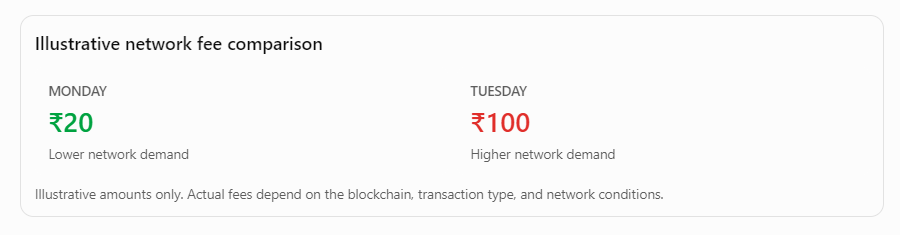
    On Monday, the blockchain has relatively low activity. Your transaction can enter the network without much competition.

    However, on Tuesday, thousands of users start making transactions at the same time.

    Now, more users are competing for limited block space. Some may offer higher fees to get their transactions processed sooner.

    As a result, the fee you see on Tuesday may be higher than the fee you saw on Monday.

    The transaction amount may be exactly the same on both days. However, the network fee can differ because the demand for processing transactions has changed.

    How can you reduce Network Fees?

    You cannot control blockchain network activity, but you can make informed decisions to manage transaction costs.

    1. Check Network Conditions Before Transferring

    Before sending cryptocurrency, check the estimated network fee. Some blockchain explorers and wallet applications provide information about current transaction costs.

    2. Avoid Peak Congestion When Possible

    If your transaction is not urgent, consider waiting for a quieter period when network demand may be lower.

    However, fees can change quickly, so there is no guaranteed low-fee time.

    3. Choose the Correct Network

    Some cryptocurrencies are available on multiple blockchain networks.

    Before transferring, check which networks the receiving wallet supports. Using an unsupported network can result in lost or inaccessible funds.

    4. Understand Transaction Complexity

    Smart contract interactions and other complex blockchain activities may require more resources than a basic transfer.

    Check the estimated fee before confirming the transaction.

    5. Review the Fee Before Confirming

    Always check the final transaction details, including the network and estimated fee, before approving a transfer.

    Common Mistakes to Avoid

    • Assuming network fees remain the same throughout the day.
    • Confusing exchange trading fees with blockchain network fees.
    • Believing that sending a smaller amount always means paying a lower network fee.
    • Choosing a different network without checking whether the receiving wallet supports it.
    • Assuming that a higher fee guarantees instant confirmation.
    • Ignoring the transaction fee before confirming a transfer.

    Remember, a low transaction fee is useful only when you are using the correct network and the transaction meets your requirements.

    Frequently Asked Questions (FAQs)

    1. Why do crypto network fees increase?

    Network fees may increase when more users compete to have their transactions processed. Limited block space and higher transaction demand can push fees upward.

    2. Are crypto network fees fixed?

    No. Many blockchain networks have variable fees that change according to network activity, transaction requirements, and their fee mechanisms.

    3. Why are Ethereum gas fees sometimes expensive?

    Ethereum gas fees can increase when demand for block space rises. Complex transactions also consume more gas, which can increase the total fee.

    4. Does sending more cryptocurrency mean paying a higher network fee?

    Not necessarily. On Bitcoin, fees mainly depend on transaction size and fee rate, rather than the amount of BTC transferred. On Ethereum, fees depend on gas used and the effective gas price.

    5. Can I avoid paying network fees?

    Most blockchain transactions require network fees. However, you may be able to reduce costs by choosing an appropriate network, checking fees before transferring, and avoiding periods of high congestion when possible.

    Disclaimer: This article is for educational purposes only and does not constitute financial or investment advice. Network fees vary depending on blockchain conditions and transaction requirements. Always verify the network and fee before confirming a transaction.