
Tag: investing basics

  • What is Market Capitalization and Why does it matter?

    Introduction

    When you first start exploring cryptocurrencies, you may notice that some coins are worth thousands of dollars while others cost only a few cents. At first glance, it may seem that a higher-priced coin is more valuable. However, price alone does not tell the full story. To better understand the size of a cryptocurrency project, investors often look at market capitalization, also known as market cap. It is one of the most commonly used metrics for comparing cryptocurrencies because it considers both a coin’s price and its circulating supply.

    What is Market Capitalization?

    Market capitalization (market cap) represents the total market value of a cryptocurrency based on its current market price and circulating supply.

    In simple terms, market capitalization helps estimate the overall size of a cryptocurrency project. Rather than focusing only on the price of one coin, it considers how many coins are currently in circulation. As a result, it provides a more meaningful way to compare different cryptocurrencies.

    Market Capitalization Formula

    Market Cap = Current Price × Circulating Supply

    Understanding the Formula

    To calculate market cap, you need two values:

    • Current Price: The latest market price of one coin or token.
    • Circulating Supply: The number of coins or tokens that are currently available and actively circulating in the market.

    By multiplying these two values, you can calculate a cryptocurrency’s market cap.

    How do you calculate market cap?

    Let’s look at a simple example.

    Suppose a cryptocurrency has:

    • Current Price: $50
    • Circulating Supply: 10 million coins

    Using the formula:

    Market Capitalization = $50 × 10,000,000 = $500 million

    In this example, the cryptocurrency has a market capitalization of $500 million.

    It is not fixed. It changes whenever the cryptocurrency’s price changes or its circulating supply changes over time.

    Why do investors use market capitalization?

    Market cap gives investors a broader perspective than price alone. It helps compare cryptocurrencies based on their overall market value instead of focusing only on the cost of a single coin.

    Compare Cryptocurrency Projects

    It allows investors to compare projects of different sizes. A cryptocurrency with a low price can still have a larger market capitalization than a higher-priced coin if its circulating supply is much larger.

    Understand Market Size

    Generally, cryptocurrencies with larger market capitalizations are more established within the market. On the other hand, smaller projects may still be growing or have lower adoption.

    Support Investment Research

    Many investors use this metric as one of several factors when researching cryptocurrencies. They also consider technology, real-world use cases, adoption, security, and community support before making investment decisions.

    Measure Market Presence

    A larger market cap often indicates that a cryptocurrency has a stronger presence within the crypto market. However, it does not guarantee future success or investment returns.

    Types of Market Capitalization

    Cryptocurrencies are commonly grouped into three categories based on their market capitalization.

    Large-Cap Cryptocurrencies

    Large-cap cryptocurrencies generally have larger market capitalizations than most other cryptocurrencies. They are often considered more established because they have gained wider adoption and recognition.

    Examples include:

    • Bitcoin (BTC)
    • Ethereum (ETH)

    Although these cryptocurrencies are widely recognized, they can still experience significant price volatility.

    Mid-Cap Cryptocurrencies

    Mid-cap cryptocurrencies have moderate market capitalizations. They may offer growth opportunities, but they also involve greater risk than many large-cap projects.

    Small-Cap Cryptocurrencies

    Small-cap cryptocurrencies have relatively lower market capitalizations. While some may have strong growth potential, they often experience higher price volatility and greater investment risk.

    What is the difference between coin price and market cap?

    One of the most common misconceptions among beginners is believing that a higher coin price means a cryptocurrency is larger or more valuable.

    In reality, this is not always true.

    Consider the following example:

    CryptocurrencyPrice per CoinCirculating SupplyMarket Capitalization
    Coin A$110 billion$10 billion
    Coin B$5001 million$500 million

    Although Coin B costs much more per coin, Coin A has a significantly larger market capitalization because far more coins are circulating.

    This example shows why investors should compare market capitalization, not just price, when evaluating cryptocurrencies.

    Limitations of Market Capitalization

    Although market capitalization is an important metric, it should not be used on its own.

    For example, market capitalization:

    • Does not measure the quality of a cryptocurrency project.
    • Does not guarantee future performance.
    • Does not reflect trading liquidity.
    • Does not measure technology or innovation.
    • Does not indicate how widely a cryptocurrency is used.

    Therefore, investors should consider additional factors such as the project’s technology, development team, adoption, security, and real-world use cases before making investment decisions.

    Frequently Asked Questions (FAQs)

    What is market capitalization in cryptocurrency?

    It is the total market value of a cryptocurrency. It is calculated by multiplying its current market price by its circulating supply.

    How is it calculated?

    The formula is:

    Market Capitalization = Current Price × Circulating Supply

    Why is market cap important?

    Market cap helps investors compare the size of different cryptocurrencies and understand their position within the broader crypto market.

    Does a higher market capitalization mean a better investment?

    No. A larger market cap may indicate that a cryptocurrency is more established, but it does not guarantee future performance or lower investment risk.

    What is the difference between price and market capitalization?

    The price is the value of one coin, while this metric represents the total market value of all coins currently in circulation.

    Disclaimer

    This article is for educational purposes only and should not be considered financial, investment, or legal advice. Cryptocurrency investments involve risk, and market prices can be highly volatile. Always conduct your own research and consider your financial goals and risk tolerance before making investment decisions.

    Trade on the Go with the Cofinex Mobile App

    Download for Android

    Download for iOS

    Follow Cofinex

    Telegram: https://t.me/cofinexofficial

    X (Twitter): https://x.com/CofinexExchange

    Facebook: https://www.facebook.com/

    Instagram: https://www.instagram.com/cofinexexchange/

    LinkedIn: https://in.linkedin.com/company/cofinexexchange

    WhatsApp Channel: https://whatsapp.com/channel/0029VbBSQtJ2P59lfbaRXJ2k
    YouTube: https://www.youtube.com/@cofinexexchange

  • What is Dollar-Cost Averaging (DCA) in crypto?

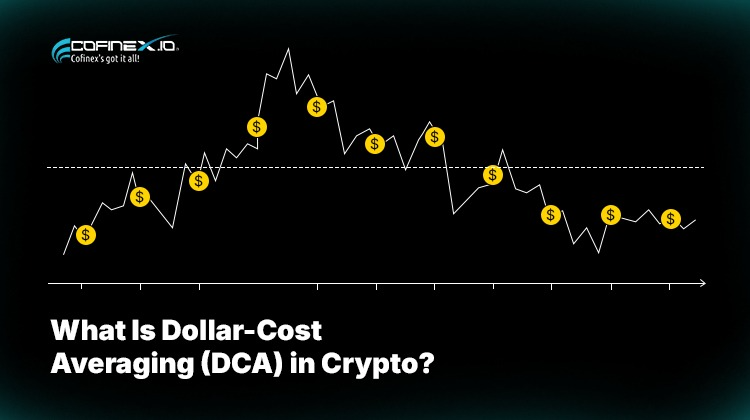
    What is Dollar-Cost Averaging (DCA) in crypto?

    Investing in cryptocurrency can feel overwhelming, especially when prices change quickly. Many beginners ask the same question: “When is the right time to buy?”

    The truth is that predicting the market consistently is extremely difficult, even for experienced investors.

    This is where Dollar-Cost Averaging (DCA) can help.

    Instead of trying to buy at the “perfect” price, DCA involves investing a fixed amount of money at regular intervals, regardless of whether the market is going up or down. This approach helps reduce emotional decision-making and encourages a consistent investing habit.

    What Is Dollar-Cost Averaging (DCA)?

    Dollar-Cost Averaging (DCA) is an investment strategy where you invest a fixed amount of money into an asset at regular intervals.

    For example, instead of investing $1,200 all at once, you might invest $100 every month for one year.

    With DCA, the amount you invest stays the same, but the number of cryptocurrency units you buy changes based on the market price.

    • When prices are lower, your fixed investment buys more cryptocurrency.
    • When prices are higher, the same investment buys fewer units.

    Over time, this approach spreads your purchases across different market conditions instead of relying on a single buying price.

    Why Do Investors Use Dollar-Cost Averaging?

    Cryptocurrency markets are known for their volatility. Prices can rise or fall significantly within a short period.

    Because of this, many investors find it difficult to decide when to invest.

    Dollar-Cost Averaging removes the pressure of trying to predict market movements. Instead of waiting for the “perfect” time, investors follow a consistent investment schedule.

    This approach can also reduce emotional decisions, such as buying during market excitement or selling during periods of fear.

    Although DCA does not eliminate investment risk, it encourages a disciplined approach to investing.

    How Does Dollar-Cost Averaging Work?

    Dollar-Cost Averaging follows a simple process.

    First, decide how much money you want to invest regularly.

    Next, choose how often you want to invest. Some people invest weekly, while others prefer monthly or quarterly investments.

    Then, continue investing the same amount regardless of the market price.

    For example, imagine you decide to invest $100 every month in Bitcoin.

    MonthBitcoin PriceAmount Invested
    JanuaryHigher$100
    FebruaryLower$100
    MarchHigher$100
    AprilLower$100

    Although the price changes each month, your investment amount remains the same.

    As a result, you buy more Bitcoin when prices are lower and less when prices are higher. Over time, this helps spread your purchases across different price levels.

    Benefits of Dollar-Cost Averaging

    Dollar-Cost Averaging offers several advantages, especially for beginners.

    Reduces Emotional Investing

    One of the biggest challenges in investing is controlling emotions.

    DCA encourages investors to follow a consistent plan instead of reacting to short-term market movements.

    Builds a Regular Investment Habit

    Investing a fixed amount regularly can help create long-term financial discipline.

    Reduces the Pressure of Market Timing

    Trying to predict the best time to invest is difficult.

    With DCA, investors focus on consistency instead of attempting to buy at the lowest possible price.

    Suitable for Volatile Markets

    Since cryptocurrency prices often fluctuate, DCA allows investors to spread their purchases over time instead of investing everything at once.

    Limitations of Dollar-Cost Averaging

    Although DCA is a popular strategy, it is not suitable for every situation.

    It is important to understand its limitations.

    • DCA does not guarantee profits.
    • It does not protect against investment losses.
    • During a consistently rising market, investing a lump sum earlier may produce better returns because more money is invested sooner.
    • Investors still need to choose suitable assets and understand the risks involved.

    For these reasons, DCA should be viewed as a strategy for managing investment timing rather than eliminating risk.

    Dollar-Cost Averaging vs Lump-Sum Investing

    Dollar-Cost AveragingLump-Sum Investing
    Invests a fixed amount regularlyInvests all available money at one time
    Reduces the need to time the marketDepends more on the market price at the time of investment
    Helps build consistent investing habitsMay benefit more during steadily rising markets
    Commonly used by beginnersOften chosen by experienced investors, depending on their strategy

    Both strategies have advantages, and neither is universally better. The most suitable approach depends on an individual’s financial goals, investment timeline, and risk tolerance.

    Is Dollar-Cost Averaging Suitable for Beginners?

    For many beginners, Dollar-Cost Averaging can be a practical way to start investing.

    It encourages consistency, reduces emotional decision-making, and removes the pressure of trying to predict short-term market movements.

    However, every investment carries risk. Before investing, take time to understand the asset you are buying and ensure it aligns with your financial goals.

    Frequently Asked Questions

    What is Dollar-Cost Averaging (DCA)?

    It is an investment strategy where you invest a fixed amount of money at regular intervals, regardless of the market price.

    Is Dollar-Cost Averaging good for beginners?

    Many beginners use DCA because it encourages consistent investing and reduces the pressure of trying to predict market movements.

    Does DCA guarantee profits?

    No. DCA is a strategy for spreading investments over time. It does not guarantee profits or protect against losses.

    Can I use DCA for Bitcoin and Ethereum?

    Yes. Many investors use it with Bitcoin, Ethereum, and other cryptocurrencies. However, it is important to research any asset before investing.

    How often should I invest using DCA?

    There is no single correct schedule. Some investors choose weekly, biweekly, or monthly investments based on their financial situation and investment plan.

    Disclaimer

    This lesson is for educational purposes only and should not be considered financial, investment, or legal advice. Dollar-Cost Averaging is an investment strategy and does not guarantee profits or prevent losses. Cryptocurrency markets are volatile, and all investments involve risk. Always conduct your own research and consider your financial goals before making investment decisions.

    Trade on the Go with the Cofinex Mobile App

    Download for Android

    Download for iOS

    Follow Cofinex

    Telegram: https://t.me/cofinexofficial

    X (Twitter): https://x.com/CofinexExchange

    Facebook: https://www.facebook.com/

    Instagram: https://www.instagram.com/cofinexexchange/

    LinkedIn: https://in.linkedin.com/company/cofinexexchange

    WhatsApp Channel: https://whatsapp.com/channel/0029VbBSQtJ2P59lfbaRXJ2k
    YouTube: https://www.youtube.com/@cofinexexchange