Tag: Decentralised Applications

  • What are smart contracts and how do they work?

    What are smart contracts and how do they work?

    Imagine buying a digital asset without depending on a traditional middleman to complete the transaction. Or consider an insurance application that processes a payout automatically when certain conditions are met.

    These are some of the possibilities that blockchain technology offers through smart contracts.

    Smart contracts help automate agreements and actions on blockchain networks. They follow predefined rules and execute operations when specific conditions are satisfied.

    As a result, they support many applications, including decentralised finance (DeFi), NFTs, gaming and digital asset management.

    But what exactly are smart contracts? How do they work, and why are they important in the blockchain ecosystem?

    Let’s understand them step by step.

    What is a smart contract?

    A smart contract is a program stored and executed on a blockchain. It contains predefined rules that determine what happens when someone interacts with it.

    Unlike a traditional agreement, which may require people or organisations to manually carry out each step, a smart contract can execute programmed actions automatically when its conditions are met.

    For example, imagine a simple digital agreement:

    • A buyer sends the required payment.
    • The smart contract checks whether the payment meets the specified conditions.
    • Once the conditions are satisfied, the contract transfers the digital asset to the buyer.

    The process follows the code written into the contract.

    However, smart contracts do not understand agreements like humans do. They execute instructions according to their programming.

    How do smart contracts work?

    Smart contracts operate through blockchain networks that support programmable transactions.

    Although the technical process can vary between networks, the general workflow follows these steps.

    1. Developers write the contract

    First, developers write the smart contract code using a programming language supported by the blockchain.

    For example, Ethereum developers commonly use Solidity to create smart contracts.

    The code defines the rules, conditions and actions that the contract can perform.

    2. The contract is deployed on the blockchain

    Next, developers deploy the completed contract to a blockchain network.

    Once deployed, the contract receives a blockchain address. Users and other applications can interact with it through that address.

    The deployment process also creates an on-chain record of the contract.

    3. A user interacts with the contract

    After deployment, a user or another smart contract can send a transaction or call a function.

    For example, someone may interact with a token contract to transfer tokens or approve another application to use them.

    4. The network executes the programmed rules

    The blockchain network processes the interaction according to its execution rules.

    If the required conditions are satisfied, the smart contract performs the relevant operation.

    However, if the transaction violates the contract’s rules or fails during execution, the requested operation may not complete successfully.

    5. The blockchain records the result

    Finally, the network records the resulting transaction and relevant state changes.

    This creates a verifiable record of the smart contract interaction.

    Therefore, users can inspect supported contract activity through a blockchain explorer.

    A simple example of a smart contract

    Imagine an online platform that sells digital event tickets.

    Traditionally, the platform may need to manage payments, ticket confirmation and delivery through its own system.

    A smart contract could automate some of these steps.

    Here’s how it might work:

    1. The event organiser creates a smart contract with ticket details and prices.
    2. A buyer selects a ticket and sends the required payment.
    3. The contract checks whether the payment meets the specified conditions.
    4. Once payment succeeds, the contract issues a digital ticket to the buyer.
    5. The blockchain records the transaction and ticket ownership.

    As a result, the platform can automate ticket issuance without manually processing every purchase.

    However, the smart contract still depends on correct programming, and real-world event entry may require additional verification systems.

    What are the main features of smart contracts?

    Smart contracts offer several features that make them useful for blockchain applications.

    1. Automation

    Smart contracts can perform predefined actions automatically when the required conditions are met.

    For example, a token transfer can occur after a successful payment. Consequently, applications may reduce the need for manual processing.

    2. Transparency

    On public blockchains, users can inspect verified smart contract code and transaction activity when the relevant information is publicly available.

    This helps users understand how a contract operates.

    However, transparency does not automatically mean that the contract is safe or free from errors.

    3. Immutability

    Once deployed, smart contract code is generally difficult to change directly.

    This helps preserve predictable execution rules. However, some contracts use upgrade mechanisms that allow authorised parties to change their implementation.

    4. Accuracy

    Smart contracts execute instructions according to their programmed rules.

    Therefore, they can reduce certain manual processing errors. However, incorrect code or faulty external information can still produce unexpected results.

    5. Decentralised execution

    On decentralised blockchain networks, participating nodes follow the network’s rules to process and verify contract execution.

    As a result, applications do not always need a single central authority to manage every operation.

    Where are smart contracts used?

    Smart contracts support several industries and blockchain applications. Here are some common examples.

    1. Decentralised finance (DeFi)

    DeFi platforms use smart contracts to provide services such as lending, borrowing, token swapping and liquidity provision.

    For example, a decentralised exchange can use smart contracts to process token swaps according to its programmed rules.

    Similarly, lending protocols can use contracts to manage deposits, collateral and borrowing conditions.

    2. Non-fungible tokens (NFTs)

    Smart contracts help create and manage NFTs.

    They can define token ownership, transfers and other programmed functions.

    For instance, when someone purchases an NFT, the smart contract can update the ownership record on the blockchain.

    3. Blockchain gaming

    Blockchain games may use smart contracts to manage digital assets, in-game tokens and certain player transactions.

    Consequently, players can interact with supported digital assets through blockchain applications.

    4. Supply chain management

    Businesses can use smart contracts to automate selected supply chain processes.

    For example, a contract may trigger a payment after receiving verified delivery information.

    However, the contract needs reliable external information to confirm that the delivery actually occurred.

    5. Digital identity and credentials

    Smart contracts can support systems that manage digital credentials, access permissions and identity-related records.

    For example, a platform may use a contract to manage membership access or verify whether a credential meets certain conditions.

    The actual identity information may remain outside the blockchain to protect privacy.

    What are the benefits of smart contracts?

    Smart contracts offer several advantages when developers implement them correctly.

    Reduced manual work: Automated execution can reduce the need for people to process every step of an agreement.

    Faster operations: Certain transactions can complete without waiting for traditional intermediaries to manually approve each action.

    Transparent records: Public blockchain networks allow users to inspect available contract activity.

    Programmable agreements: Developers can create applications with customised rules and conditions.

    Consistent execution: Smart contracts follow the same programmed instructions whenever the relevant conditions are met.

    However, these benefits depend on the quality of the code, the blockchain network and any external services the contract uses.

    What are the risks and limitations of smart contracts?

    Although smart contracts provide useful features, they also carry important risks.

    1. Coding errors

    A mistake in the contract’s code may create vulnerabilities or cause unexpected behaviour.

    For example, an attacker may exploit a weakness to access funds or interfere with contract operations.

    2. Irreversible transactions

    Many blockchain transactions cannot be easily reversed after confirmation.

    Therefore, an incorrect transfer or unintended contract interaction may result in permanent losses.

    3. External data risks

    Some smart contracts depend on information from outside the blockchain.

    If an oracle provides inaccurate information, the contract may execute an action based on incorrect data.

    4. Upgrade limitations

    Some smart contracts cannot be changed easily after deployment.

    In contrast, upgradeable contracts may allow authorised parties to modify certain functions. However, this can introduce additional trust and security considerations.

    5. Network fees

    Interacting with smart contracts usually requires network resources and may involve transaction fees.

    These fees can change depending on network demand and the complexity of the operation.

    6. Legal and regulatory uncertainty

    A smart contract does not automatically replace a legally recognised agreement.

    Its legal treatment depends on the jurisdiction, the nature of the transaction and applicable laws.

    Therefore, users should not assume that every smart contract has the same legal status as a traditional contract.

    Smart contracts vs traditional contracts

    Both types of contracts define agreements, but they work differently.

    FeatureTraditional contractSmart contract
    FormatUsually written in legal or natural languageWritten as executable computer code
    ExecutionOften requires people or organisationsExecutes programmed actions on a supported network
    StoragePhysical documents or digital systemsBlockchain network
    ChangesCan be amended through agreed processesDepends on the contract’s design and upgrade permissions
    VerificationMay involve legal or administrative processesContract activity can be checked through blockchain records
    Human involvementOften required for administration and enforcementCan automate selected operations

    Importantly, smart contracts and traditional legal contracts are not necessarily alternatives. Some arrangements may use both.

    Can smart contracts be changed after deployment?

    It depends on how developers design the contract.

    Some smart contracts have no built-in upgrade mechanism. Their deployed code remains fixed, although users may interact with a newer contract if developers create one.

    Other contracts use upgradeable designs, such as proxy contracts. In these systems, authorised parties can change the implementation while keeping the same proxy address.

    However, upgrade permissions introduce additional risks. Users should understand who controls those permissions and what changes they can make.

    Frequently asked questions

    Are smart contracts legal?

    Smart contracts may have legal significance in some situations, but their legal status depends on the jurisdiction and the specific agreement. Executable code does not automatically satisfy every legal requirement.

    Do smart contracts need a blockchain?

    Smart contracts, in the blockchain sense discussed in this article, operate on blockchain networks. However, automated agreements and programmable rules can also exist in ordinary software systems.

    Can smart contracts hold cryptocurrency?

    Yes. Smart contracts on supported blockchain networks can manage and transfer digital assets according to their programmed permissions and rules.

    Can a smart contract make mistakes?

    A smart contract follows its code, but developers can introduce coding errors or incorrect assumptions. Consequently, a contract may produce unexpected results even when it executes exactly as programmed.

    Are all smart contracts public?

    Not necessarily. On public blockchains, contract code and activity may be publicly accessible when verified. However, private blockchain networks and different implementation choices can restrict visibility.

    Key takeaways

    Smart contracts are blockchain-based programs that execute predefined instructions when specified conditions are met.

    They help automate operations such as token transfers, lending, NFT ownership and digital asset management.

    In addition, smart contracts provide programmable execution and verifiable transaction records. However, coding errors, external data risks, network fees and upgrade permissions can create challenges.

    Ultimately, smart contracts are an important part of blockchain technology because they allow networks to do more than record transactions. They make it possible to build applications that follow automated rules without depending entirely on traditional intermediaries.

    Disclaimer: This article is for educational purposes only. It does not constitute financial, investment, legal or technical advice. Always review a smart contract’s code, permissions and security audits before interacting with it.
  • What is the difference between on-chain and off-chain data?

    What is the difference between on-chain and off-chain data?

    Blockchains are designed to record information in a way that multiple participants can verify. However, not every piece of information connected to a blockchain needs to be stored directly on it.

    Some data lives on the blockchain, while other information stays outside the network. These two approaches are known as on-chain data and off-chain data.

    Understanding the difference is important because it helps explain how blockchain applications manage information, protect privacy and handle large amounts of data.

    But what exactly do these terms mean? Let’s explore how they work, where they are used and what advantages and limitations they carry.

    What is on-chain data?

    On-chain data refers to information recorded directly on a blockchain.

    Once a transaction becomes part of a confirmed block, the network stores its relevant data according to the blockchain’s design. Network participants can use this information to verify transactions and understand the blockchain’s history.

    For example, when someone transfers cryptocurrency from one wallet to another, the blockchain records information about that transaction.

    Depending on the network, this may include:

    • Sender and receiver addresses.
    • Amount transferred.
    • Transaction fee.
    • Transaction timestamp or block position.
    • Transaction status and related execution details.

    Smart contract interactions also create on-chain records. These may include contract calls, token transfers, state changes and events.

    How does on-chain data work?

    Let’s take a simple example.

    Suppose a user sends 0.5 ETH to another wallet.

    1. The user creates and signs the transaction.
    2. The transaction gets broadcast to the Ethereum network.
    3. Validators process it according to the network’s rules.
    4. Once included in a block, the transaction becomes part of the blockchain’s record.
    5. Anyone with access to the appropriate blockchain explorer can inspect its publicly available details.

    As a result, the network provides a shared record that participants can independently verify.

    However, the exact information available depends on the blockchain and transaction type.

    What is off-chain data?

    Off-chain data refers to information stored or processed outside the blockchain itself.

    Instead of recording every detail directly on the network, an application may use external databases, cloud storage systems, servers or decentralised storage networks.

    This approach helps applications manage information that may be too large, sensitive or expensive to store directly on a blockchain.

    For example, an NFT may represent ownership of a digital artwork. The blockchain can record the token and its ownership details, while the actual image file may live in an external storage system.

    Other examples of off-chain data include:

    • Large images and videos.
    • Documents and digital certificates.
    • User profiles and application settings.
    • Private business information.
    • External market data.
    • Information collected from real-world devices.

    Importantly, off-chain data does not always mean centralised data. Applications can use decentralised storage systems as well.

    How does off-chain data work?

    Imagine an application that allows users to purchase digital artwork.

    The process could work like this:

    1. The creator uploads the artwork to a storage system.
    2. The application stores a reference or content identifier for the artwork.
    3. A blockchain transaction records the NFT and its ownership information.
    4. Users can view the artwork through the application using its stored reference.

    In this example, the blockchain records ownership-related information, while the artwork itself remains outside the blockchain.

    This reduces the need to store large files directly on the network.

    On-chain vs off-chain data: Key differences

    Both approaches serve different purposes. The following table explains their main differences.

    FeatureOn-chain dataOff-chain data
    Storage locationDirectly on a blockchainOutside the blockchain
    VerificationCan be checked using blockchain recordsDepends on the storage system and verification method
    TransparencyOften publicly visible on public blockchainsAccess depends on permissions and storage design
    ModificationConfirmed historical records are generally difficult to changeCan often be updated or deleted by authorised parties
    CostMay require network fees and blockchain storage costsDepends on the external storage or service
    Data capacityLimited by network design and economic costsCan support larger files and datasets
    PrivacyPublic records may expose informationCan support access restrictions and private storage
    ExamplesTransactions, smart contract activity, token transfersImages, videos, documents and external datasets

    One important point: on-chain data is not automatically private, and off-chain data is not automatically secure. Both depend on how the system is designed.

    Why do blockchain applications use both?

    Storing everything on a blockchain is not always practical. Blockchains have limited capacity, and storing large amounts of information can become expensive.

    Therefore, many applications combine on-chain and off-chain systems.

    This approach allows them to use blockchain for important records while keeping larger or frequently changing information elsewhere.

    Here are some common examples.

    1. NFTs and digital assets

    An NFT may record ownership and token information on a blockchain.

    However, the associated image, video or other media may remain in external storage.

    In this arrangement, the blockchain records the token, while the external system provides the associated content.

    The reliability of the content also depends on the storage system and whether the referenced file remains available.

    2. Decentralised finance (DeFi)

    DeFi applications use smart contracts to record important financial operations, such as token swaps, lending activity and collateral changes.

    However, they may also depend on off-chain information.

    For example, a blockchain oracle can provide external market prices to a smart contract. The oracle acts as a bridge between information outside the blockchain and applications running on it.

    3. Supply chain management

    Businesses can use blockchain networks to record important supply chain events, such as product movement, ownership transfers or delivery confirmations.

    Meanwhile, detailed documents, photographs and sensor information may remain in external systems.

    This helps businesses keep important records verifiable without placing every document directly on the blockchain.

    4. Blockchain gaming

    Blockchain games may record token ownership, digital item transfers and selected game-related activities on-chain.

    However, graphics, player profiles and large game files generally remain off-chain.

    This allows games to manage large amounts of information without recording every action on the blockchain.

    What are the benefits of on-chain data?

    On-chain data offers several advantages.

    Transparency: On public blockchains, participants can inspect available transaction records and smart contract activity.

    Verifiability: Users can independently check recorded transactions instead of relying entirely on a company’s internal database.

    Tamper resistance: Confirmed records are generally difficult to alter because blockchain networks use cryptographic and consensus mechanisms.

    Shared records: Multiple participants can refer to the same blockchain history rather than maintaining separate records.

    However, these benefits depend on the blockchain’s security, decentralisation and implementation.

    What are the benefits of off-chain data?

    Off-chain storage also offers important advantages.

    Lower storage costs: Applications can avoid paying blockchain fees for every large file or data update.

    Greater flexibility: External information can often be updated without creating a new blockchain transaction.

    Better data management: Applications can handle large files, complex databases and frequently changing information.

    Privacy options: Developers can restrict access to sensitive information through permissions and encryption.

    However, off-chain systems introduce dependencies on storage providers, databases, availability and data integrity.

    What are the risks of on-chain and off-chain data?

    Neither approach is completely risk-free.

    Risks of on-chain data

    • Public records may expose wallet activity and transaction patterns.
    • Blockchain transactions can be difficult or impossible to reverse.
    • Storing large amounts of information can become expensive.
    • Incorrect information recorded on-chain may remain in the historical record.

    Risks of off-chain data

    • External servers or storage providers may experience downtime.
    • Data may become unavailable if a provider shuts down.
    • Centralised databases can become targets for cyberattacks.
    • External information may be changed or manipulated.
    • Applications may depend on third parties to retrieve or verify data.

    Therefore, developers must carefully decide which information belongs on-chain and which information should remain off-chain.

    What is the role of blockchain oracles?

    Blockchain oracles help smart contracts access information from outside their blockchain network.

    For example, a DeFi smart contract may need the current price of ETH to calculate collateral requirements.

    However, the blockchain cannot automatically access every external website, database or real-world information source.

    An oracle provides the required information to the smart contract.

    This is particularly important when applications combine on-chain operations with off-chain information.

    However, the reliability of the application also depends on the oracle’s accuracy, security and availability.

    Frequently asked questions

    Is on-chain data always public?

    No. Public blockchains generally allow participants to inspect their available records. However, some blockchain systems use permission controls or privacy technologies to restrict access to certain information.

    Is off-chain data less secure than on-chain data?

    Not necessarily. Off-chain systems can use encryption, access controls and secure storage. However, their security depends on the providers, infrastructure and verification methods involved.

    Can off-chain data be stored permanently?

    It depends on the storage system. Some decentralised storage networks are designed to improve long-term availability, but storage does not automatically guarantee permanent access.

    Can smart contracts access off-chain data directly?

    Not in the same way they access information within their own blockchain environment. Smart contracts generally need an oracle or another external mechanism to receive off-chain information.

    Why don’t blockchains store everything on-chain?

    Storing every file and data update directly on a blockchain can increase costs and create scalability challenges. Therefore, applications often keep essential records on-chain and use external systems for larger datasets.

    Disclaimer: This article is for educational purposes only. It does not constitute financial, investment or technical advice. Always review the security, privacy and data management practices of any blockchain application before using it.

  • How do smart contract upgrades work and why do they matter?

    How do smart contract upgrades work and why do they matter?

    Smart contracts are an important part of blockchain technology. They power decentralised applications, token transfers, lending platforms, NFT marketplaces, and many other blockchain-based services.

    However, what happens when a smart contract contains a bug, needs a security improvement, or requires a new feature?

    Unlike traditional software, smart contracts often run on blockchains where deployed code cannot simply be edited like a regular application. Therefore, developers need specific methods to update or replace smart contracts.

    This process is known as a smart contract upgrade.

    In this lesson, we will explore how smart contract upgrades work, why projects need them, and what risks users should understand before interacting with upgradeable contracts.

    1. What is a smart contract?

    A smart contract is a programme deployed on a blockchain that executes instructions when predefined conditions are met.

    For example, imagine a decentralised lending application. A smart contract can manage deposits, calculate interest according to its programmed rules, and process eligible withdrawals.

    Once deployed, the contract operates according to its code and the rules of the blockchain.

    However, developers may discover problems or identify opportunities to improve the contract after deployment. In such cases, an upgrade may become necessary.

    2. What is a smart contract upgrade?

    A smart contract upgrade is a process used to change or improve the functionality of an existing blockchain application.

    An upgrade may introduce new features, fix vulnerabilities, improve performance, or modify existing rules.

    For example, suppose a decentralised application has a smart contract that supports token deposits and withdrawals. Later, developers identify a security weakness in its withdrawal process.

    They may introduce an updated contract that addresses the issue.

    However, the method used to upgrade a contract depends on how developers designed it before deployment.

    Importantly, not every smart contract can be upgraded directly. Some contracts are designed to remain unchanged after deployment.

    3. Why do smart contracts need upgrades?

    Although developers test smart contracts before deployment, no software is completely free from errors or vulnerabilities.

    Here are some common reasons why projects upgrade their contracts.

    Security improvements

    Security is one of the main reasons for contract upgrades.

    Developers may discover vulnerabilities that could allow unauthorised access, incorrect transactions, or loss of funds. Therefore, they may need to introduce changes to reduce these risks.

    However, an upgrade cannot guarantee complete security. The updated code must also undergo careful testing and review.

    Bug fixes

    Sometimes, a contract may contain programming errors that affect how it performs certain operations.

    For example, a calculation error could cause a reward distribution mechanism to work incorrectly.

    Developers may release an updated implementation to correct the issue.

    Adding new features

    Blockchain applications evolve over time. As a result, developers may introduce new features to improve the user experience or support additional services.

    For instance, a decentralised finance application may update its contract to support another token or introduce a new lending feature.

    Improving efficiency

    Developers may also upgrade contracts to improve how they use blockchain resources.

    For example, changes may reduce unnecessary operations or make certain processes more efficient. However, any proposed change must still follow the rules of the blockchain.

    Adapting to changing requirements

    A project may need to change its contract logic as its ecosystem grows.

    For example, developers may update governance rules, introduce new reward mechanisms, or modify certain parameters to support the application’s development.

    4. How do smart contract upgrades work?

    There are different ways to upgrade smart contracts. The approach depends on the contract’s original design.

    Let’s understand three common methods.

    Method 1: Deploying a new contract

    One straightforward method is to deploy a completely new smart contract.

    Developers create an updated version, test it, and deploy it to the blockchain.

    After deployment, the project may ask users to interact with the new contract instead of the old one.

    For example, a token project may deploy a new contract to introduce improved functionality. Depending on the design, users may need to transfer or migrate their tokens to the new contract.

    However, this method can create additional work for users and developers. The old contract may also remain on the blockchain, even after the project stops using it.

    Method 2: Proxy contracts

    A proxy contract is a common method for creating upgradeable smart contracts.

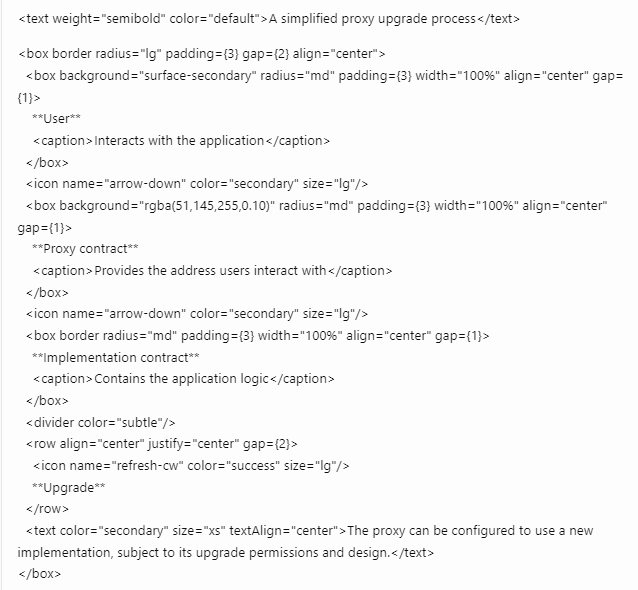
    In this arrangement, users interact with a proxy contract, which delegates execution to another contract called the implementation contract.

    The proxy generally maintains the relevant storage, while the implementation contract contains the logic used to execute operations.

    When developers upgrade the application, they can change which implementation the proxy points to.

    This allows the application to use updated logic while retaining the proxy address and, when correctly designed, its existing state.

    Although proxy contracts make upgrades easier, they introduce additional considerations. For example, incorrect storage layouts or poorly controlled upgrade permissions can create serious security problems.

    Method 3: Diamond pattern

    The Diamond pattern is another approach to building upgradeable smart contracts.

    Instead of relying on one large implementation contract, it divides functionality into smaller modules called facets.

    Each facet handles specific functions. A central diamond contract routes user requests to the relevant facet.

    Developers can add, replace, or remove certain facets without replacing the entire application structure.

    This approach can be useful for complex applications. However, it also introduces additional design and security considerations.

    5. Who controls smart contract upgrades?

    One important question is: who has permission to change a smart contract?

    The answer depends on the project’s governance and contract design.

    Some projects allow a development team or administrator to approve upgrades. Others use multisignature wallets, decentralised governance, or time-lock mechanisms.

    Here are some common arrangements:

    • Admin-controlled upgrades: A designated administrator can approve or execute contract changes.
    • Multisignature approval: Multiple authorised signers must approve an upgrade before it can proceed.
    • DAO governance: Token holders or designated governance participants vote on proposed changes, according to the project’s rules.
    • Timelock mechanism: An approved upgrade must wait for a specified period before execution.

    These arrangements can improve accountability, but they do not automatically make a contract safe.

    For example, if one administrator has unrestricted upgrade permissions, that person or compromised account may be able to change the contract’s behaviour.

    Therefore, always check who controls the upgrade mechanism.

    6. What are the risks of smart contract upgrades?

    Upgradeable contracts offer flexibility, but they also introduce risks that users should understand.

    Centralisation risk

    If only one person or organisation controls upgrades, users must trust that authority to act responsibly.

    A compromised administrator account could potentially approve harmful changes.

    Malicious upgrades

    An authorised upgrade mechanism could be misused to introduce harmful code.

    Depending on the contract’s permissions and design, this could affect user balances, withdrawals, or other application functions.

    Storage compatibility problems

    Upgradeable contracts must handle stored data carefully.

    For example, a poorly designed implementation update may change how the contract reads or writes existing data. This can lead to unexpected behaviour or application failures.

    New vulnerabilities

    An upgrade intended to improve security may introduce new bugs.

    Therefore, developers should test updated code and arrange appropriate security reviews before implementation.

    Governance risks

    If upgrades depend on community voting, low participation or concentrated voting power may affect decisions.

    As a result, governance processes should be transparent and clearly documented.

    User confusion

    Some upgrades require users to migrate tokens, approve new contracts, or take other actions.

    Without clear communication, users may interact with outdated contracts or fall victim to fake upgrade announcements.

    Always verify upgrade instructions through official project channels.

    7. How can users check whether a smart contract is upgradeable?

    You do not need to be a blockchain developer to perform basic checks.

    However, you should know where to look.

    Here are some useful steps:

    1. Check the contract address: Find the official address through the project’s verified website or documentation.
    2. Use a blockchain explorer: Open the contract on an explorer such as Etherscan.
    3. Review the contract information: Look for verified source code and proxy indicators, where available.
    4. Check upgrade permissions: Examine whether an administrator, multisignature wallet, or governance mechanism controls upgrades.
    5. Review upgrade history: Check whether the implementation address or contract logic has changed.
    6. Read official announcements: Verify whether the project has explained the reason and impact of an upgrade.

    A blockchain explorer can help you inspect contract activity and verified code. However, interpreting proxy permissions and implementation details may require technical knowledge.

    8. Upgradeable vs immutable smart contracts

    Not every project chooses to make its smart contracts upgradeable.

    Some contracts are designed to remain immutable, meaning their deployed code cannot be changed through an administrative upgrade mechanism.

    Upgradeable contractsImmutable contracts
    Can support changes through an upgrade mechanismDeployed code cannot be directly changed
    Allow developers to fix bugs or add features through upgradesChanges generally require deploying a new contract
    May depend on administrators or governanceAvoid certain upgrade-control risks
    Require users to consider upgrade permissionsStill carry risks from original code and design

    Neither approach is automatically better in every situation.

    Upgradeable contracts offer flexibility, while immutable contracts provide stronger guarantees that their deployed logic will not be changed through an upgrade mechanism.

    However, immutability does not guarantee that a contract is secure or free from bugs.

    Final thoughts

    Smart contract upgrades help blockchain applications adapt, improve security, fix bugs, and introduce new features.

    At the same time, they create important questions about permissions, governance, storage compatibility, and user protection.

    Before interacting with an upgradeable contract, understand who controls it, how upgrades are approved, and whether the project communicates changes transparently.

    Most importantly, remember that an upgradeable contract is not automatically unsafe, and an immutable contract is not automatically secure. The quality of the code, security practices, and governance structure all matter.

    Frequently asked questions

    1. Can smart contracts be changed after deployment?

    Some smart contracts can be upgraded through mechanisms such as proxy contracts. However, contracts without an upgrade mechanism generally cannot have their deployed code directly modified.

    2. What is a proxy contract in blockchain?

    A proxy contract is a contract that allows users to interact with an application while delegating execution to a separate implementation contract. Developers can update the implementation without necessarily changing the proxy address.

    3. Are upgradeable smart contracts safe?

    Upgradeable contracts can be useful, but their safety depends on code quality, testing, upgrade permissions, governance, and security practices. Poorly controlled upgrade mechanisms can create additional risks.

    4. What is an immutable smart contract?

    An immutable smart contract is designed so that its deployed code cannot be directly changed through an upgrade mechanism. If developers need different functionality, they generally deploy another contract.

    5. Who can approve a smart contract upgrade?

    Depending on the design, upgrades may be controlled by an administrator, a multisignature wallet, a DAO governance process, or another authorised mechanism.

    6. Does a smart contract audit guarantee that an upgrade is safe?

    No. An audit reviews code within a defined scope, but it cannot guarantee complete security. Updated implementations should also undergo appropriate testing and security reviews.

    Disclaimer

    This article is intended for educational and informational purposes only. It does not constitute financial, investment, legal, or technical advice. Smart contract upgrades involve potential security, governance, and operational risks. Always verify contract addresses, review official documentation, and conduct independent research before interacting with blockchain applications.