Tag: Crypto Risk Management

  • 5 Rules for Volatile Crypto Markets

    5 Rules for Volatile Crypto Markets

    Introduction

    Cryptocurrency markets can change quickly. Prices may rise or fall sharply within minutes, creating opportunities as well as significant risks. During volatile periods, traders may feel pressured to act quickly, follow market hype, or increase their positions to recover losses.

    However, successful risk management does not depend on predicting every price movement. Instead, it involves setting clear limits, making informed decisions, and preparing for unexpected market changes.

    In this lesson, you will learn five practical rules to help manage risk during volatile crypto markets.

    1. Set a Risk Limit Before Trading

    Before entering a trade, decide how much money you can afford to lose. A predefined risk limit helps prevent emotional decisions when prices move against you.

    For example, imagine you have a trading account worth ₹10,000. You decide that you are willing to risk ₹100 on a particular trade. This amount represents 1% of your account balance.

    Setting this limit does not guarantee that your loss will remain exactly ₹100. Market gaps, slippage, fees, and execution conditions can affect the final result. Nevertheless, a clear limit provides a starting point for managing exposure.

    Remember: Never risk money you need for essential expenses, and avoid increasing your risk simply because a previous trade resulted in a loss.

    2. Use Position Sizing

    Position sizing determines how much of an asset you buy or sell in a trade. It helps you control your potential loss rather than choosing a trade size based only on confidence or available funds.

    Consider this example:

    Trading detailExample
    Account balance₹10,000
    Planned risk1% of account
    Maximum planned loss₹100
    Entry price₹500
    Stop-loss price₹490
    Risk per unit₹10
    Position size10 units
    Total position value₹5,000

    In this example, buying 10 units creates a planned price risk of ₹100 if the exit executes at ₹490, excluding fees and slippage.

    The key point is that your position size should reflect your risk limit and the distance between your entry and exit levels.

    3. Check Liquidity Before Trading

    Liquidity refers to how easily you can buy or sell an asset without significantly affecting its market price.

    During volatile periods, liquidity can change quickly. Some trading pairs may have fewer buyers and sellers, wider bid-ask spreads, or limited order-book depth.

    Low liquidity can lead to slippage, which occurs when your trade executes at a different price than expected.

    Before trading, check:

    • Trading volume: Review recent activity, but do not treat volume alone as proof of healthy liquidity.
    • Order-book depth: Examine available buy and sell orders near the current market price.
    • Bid-ask spread: A wider spread can increase trading costs.
    • Expected slippage: Consider how your order size may affect the execution price.

    A coin that is trending on social media may still have limited liquidity. Therefore, investigate the actual trading conditions before placing an order.

    4. Avoid Excessive Leverage

    Leverage allows traders to control a larger position using a smaller amount of capital. Although it can increase potential gains, it also magnifies losses.

    For example, with 10× leverage, a 1% adverse price movement can create an approximately 10% loss relative to the initial margin, before fees and other adjustments. The actual result depends on the product’s rules and position structure.

    If the market moves sharply against a leveraged position, the exchange may liquidate it when the applicable margin requirements are no longer met.

    To manage this risk:

    • Understand how leverage and liquidation work before trading.
    • Avoid using the maximum leverage available.
    • Never assume a stop-loss order will always execute at its exact trigger price.
    • Consider whether you can manage the position without borrowing or using leverage.

    For beginners, learning how spot trading works before exploring leveraged products can help build a stronger foundation.

    5. Verify Information Before Trading

    Crypto markets often react to news, social media posts, influencer opinions, and community discussions. However, not every claim is accurate or complete.

    False announcements, misleading price predictions, fake partnerships, and rumours can influence trading decisions.

    Before acting on information:

    1. Check official project announcements and reliable sources.
    2. Confirm dates, details, and context.
    3. Be cautious of posts promising guaranteed profits.
    4. Avoid making rushed decisions because someone claims an opportunity will disappear.
    5. Compare multiple sources when a claim could significantly affect your decision.

    Even verified information does not guarantee a particular market reaction. Prices may already reflect the news, or traders may interpret it differently.

    Common Mistakes to Avoid During Volatile Markets

    Even experienced traders can make mistakes when market conditions become unpredictable. Watch out for these common behaviours:

    • Chasing sudden price increases: Buying only because an asset is rising can expose you to sharp reversals.
    • Revenge trading: Trying to recover losses immediately may lead to larger, poorly planned trades.
    • Ignoring trading costs: Fees, spreads, and slippage can reduce returns.
    • Overtrading: Frequent trades may increase costs and encourage impulsive decisions.
    • Treating risk controls as guarantees: Stop-loss orders and position-sizing methods can reduce risk, but they cannot eliminate losses.

    Instead, follow a written trading plan and review your decisions regularly.

    A Simple Pre-Trade Checklist

    Before placing a trade, ask yourself these five questions:

    • Have I set a clear risk limit?
    • Is my position size appropriate for that limit?
    • Have I checked liquidity, spreads, and potential slippage?
    • Do I understand the risks of leverage, if applicable?
    • Have I verified the information behind my decision?

    If you cannot answer these questions confidently, consider pausing until you have enough information.

    Most importantly, no trading method can eliminate losses or guarantee profits. Risk management helps you make more disciplined decisions, but market conditions can still produce unexpected outcomes.

    Frequently Asked Questions

    What is the most important rule for volatile crypto markets?

    Start by setting a clear risk limit. Knowing how much you can afford to lose helps guide your position size and reduces the temptation to make impulsive decisions.

    Does using a stop-loss guarantee that I will not lose more than planned?

    No. A stop-loss can help manage risk, but the final execution price may differ from the trigger price because of gaps, volatility, or slippage.

    Is leverage safe during volatile markets?

    Leverage increases exposure and can magnify losses. Sudden price movements may also trigger liquidation. Traders should understand these risks before using leveraged products.

    Can risk management prevent all trading losses?

    No. Risk management can help control exposure and support more disciplined decisions, but it cannot remove market risk or guarantee a positive outcome.

    Disclaimer: This article is for educational purposes only and does not constitute financial advice. Cryptocurrency trading involves substantial risk, and you may lose some or all of your invested capital.
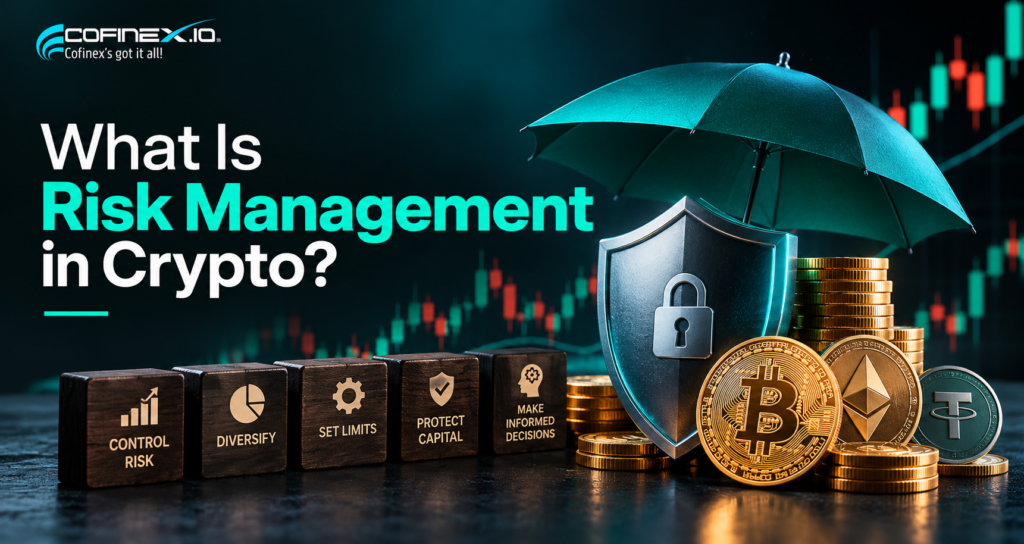
  • What is Risk Management in Crypto?

    Introduction

    Cryptocurrency can offer opportunities, but it also comes with significant risks. Prices can move quickly, markets can become volatile, and individual crypto assets can lose value.

    Because of this, knowing how to manage risk is just as important as understanding how crypto works.

    Crypto risk management is not about predicting every market move or avoiding losses completely. Instead, it is about making decisions that help you control how much you are willing to risk.

    For beginners, a good risk management approach can help prevent one investment or trade from having an unnecessarily large impact on the overall portfolio.

    What Is Risk Management in Crypto?

    Crypto risk management means identifying, understanding, and managing the risks involved in cryptocurrency investing and trading.

    These risks can come from different sources, including:

    • Market volatility
    • Large price movements
    • Concentration in one asset
    • Poor investment decisions
    • Leverage
    • Security problems
    • Project-related risks
    • Emotional trading

    The goal is not to remove every risk. Instead, the goal is to understand those risks and decide how much exposure you are comfortable taking.

    Why Is Risk Management Important?

    Crypto markets can move sharply within short periods.

    For example, imagine an investor puts their entire portfolio into one cryptocurrency. If that asset falls significantly, the investor’s entire portfolio is exposed to that decline.

    However, someone who spreads their exposure across different assets may reduce their dependence on one investment.

    This is one reason portfolio diversification can be part of a broader risk management strategy.

    Still, diversification does not guarantee protection. Different crypto assets can fall together when the broader market declines.

    Understand Your Risk Tolerance

    Before investing or trading, it is important to understand your risk tolerance.

    Risk tolerance refers to how much potential loss you are financially and emotionally prepared to accept.

    For example, one person may be comfortable with large price fluctuations. Another person may find the same movements difficult to handle.

    Your risk tolerance can depend on:

    • Financial situation
    • Investment goals
    • Time horizon
    • Existing investments
    • Experience with volatile markets

    Therefore, an investment strategy that works for one person may not be suitable for another.

    Avoid Investing More Than You Can Afford to Lose

    One of the basic principles of crypto risk management is to avoid putting money at risk that you cannot afford to lose.

    Cryptocurrency prices can be unpredictable. Even projects that appear strong can face unexpected challenges.

    For this reason, crypto investments should not come at the expense of essential expenses, emergency savings, or other important financial obligations.

    A simple rule for beginners is:

    Only take risks that fit your financial situation.

    How Does Diversification Help?

    Diversification means spreading investments across different assets rather than relying on one investment.

    For example, instead of holding only one cryptocurrency, an investor may hold different assets based on their goals and risk tolerance.

    Diversification can help reduce concentration risk.

    However, owning many cryptocurrencies does not automatically create a well-diversified portfolio. Several crypto assets may respond similarly to major market events.

    So, the goal should not simply be to own more assets. Instead, understand what you own and why you own it.

    What Is Position Sizing?

    Position sizing refers to deciding how much of your portfolio or available capital to put into a particular investment or trade.

    For example, suppose someone has ₹1,00,000 available for investment.

    Putting the entire amount into one highly volatile asset creates much greater exposure than allocating only a smaller portion to that asset.

    Position sizing can therefore help control the impact of an individual investment.

    There is no universal percentage that works for everyone. The appropriate amount depends on factors such as risk tolerance, investment goals, and the asset itself.

    Understand Crypto Volatility

    Volatility describes how much and how quickly an asset’s price changes.

    Cryptocurrency markets can experience significant price movements. Therefore, investors should be prepared for the possibility of both rapid gains and sharp declines.

    For beginners, it is important to avoid making decisions based only on short-term price movements.

    Instead, consider:

    • Why are you investing?
    • How long do you plan to hold?
    • How much loss can you tolerate?
    • Has the risk of the investment changed?

    This approach can help reduce emotional decisions.

    What About Stop-Loss Orders?

    A stop-loss order is a trading tool that can help traders limit potential losses by triggering an order when the market reaches a specified price.

    For example, a trader may decide that they do not want to continue holding a position if the price falls to a certain level.

    However, stop-loss orders are not a perfect safety mechanism.

    In a fast-moving or low-liquidity market, the final execution price may differ from the expected level. Therefore, beginners should understand how their exchange handles stop orders before using them.

    Stop-loss orders are mainly relevant to trading, rather than being a requirement for every long-term investment.

    Be Careful With Leverage

    Leverage allows traders to control a larger position using a smaller amount of capital.

    While leverage can increase potential returns, it can also increase potential losses.

    For example, a small price movement against a leveraged position can have a much larger effect on the trader’s available capital.

    As a result, beginners should understand leverage thoroughly before using it.

    If you do not understand how liquidation, margin, and leveraged positions work, avoiding leverage while learning may reduce unnecessary risk.

    Security Is Also Part of Risk Management

    Risk management is not only about price movements.

    Crypto holders also need to consider security risks.

    For example:

    • Protect your private keys.
    • Keep your recovery phrase private.
    • Use strong passwords.
    • Enable two-factor authentication where available.
    • Be careful with suspicious links and messages.
    • Verify wallet addresses before sending funds.

    Even if an investment performs well, poor security practices can still result in a loss.

    Common Risk Management Mistakes

    Investing Based on Emotions

    Fear and excitement can influence decisions. Buying because prices are rising rapidly or selling because of panic can lead to poor choices.

    Putting Everything Into One Asset

    This creates high concentration risk.

    Using Too Much Leverage

    Leverage can magnify losses as well as gains.

    Ignoring Volatility

    Crypto prices can move much faster than beginners expect.

    Following Someone Else’s Strategy

    Another person’s risk tolerance and financial situation may be completely different from yours.

    Chasing Quick Profits

    Trying to make fast returns can encourage unnecessary risk-taking.

    Forgetting Security

    Investment risk is not the only risk. Wallet and account security matter too.

    A Simple Risk Management Example

    Imagine you have ₹1,00,000 that you have decided to allocate toward investments.

    Instead of putting the entire amount into one highly volatile cryptocurrency, you may choose to spread your exposure based on your financial goals and risk tolerance.

    You could also decide in advance:

    • How much you are comfortable allocating to crypto
    • How much exposure you want to one asset
    • Whether you will use leverage
    • How long you plan to hold
    • What conditions would make you reconsider the investment

    The exact allocation is a personal decision. There is no single formula that works for every investor.

    The important part is planning the risk before making the investment, rather than reacting after a large price movement occurs.

    FAQs

    Is crypto risk management only for traders?

    No. Both investors and traders can benefit from risk management. However, the tools they use may differ.

    Does diversification eliminate crypto risk?

    No. Diversification can reduce concentration risk, but several crypto assets can still decline at the same time.

    Is leverage a risk management strategy?

    No. Leverage increases exposure and can magnify both gains and losses. It should be understood as a higher-risk trading tool.

    Can a stop-loss guarantee that I will lose only a fixed amount?

    No. In fast-moving or low-liquidity markets, execution can occur at a different price from the stop level.

    What is the most important part of risk management?

    There is no single rule for everyone. Understanding your financial situation, risk tolerance, investment goals, and exposure is a good starting point.

    Disclaimer

    This article is for educational purposes only and does not provide financial or investment advice. Cryptocurrency investments and trading involve significant risks, including the possible loss of capital. Always conduct your own research and consider your financial circumstances before making investment decisions.