Category: Investment Basics

  • What is Copy Trading? How does it work?

    What is Copy Trading? How does it work?

    Introduction

    Cryptocurrency trading can be challenging when you’re just getting started. Markets move quickly, prices can change suddenly, and making trading decisions often requires time, research, and experience.

    Some crypto trading platforms offer a feature called copy trading. This feature allows users to automatically follow and replicate another trader’s positions.

    Instead of deciding when to buy or sell every time, users can select a trader and allocate a specific amount of funds to the strategy.

    As a result, this approach can make the trading process more convenient. It does not remove market risk or guarantee profits. Understanding the process is important before using the feature.

    What is Copy Trading?

    Copy trading is a trading method that allows users to automatically replicate the trades of another trader.

    For example, imagine that a selected trader buys Bitcoin. If you follow that trader through a supported platform, the system may automatically place a corresponding trade in your account.

    Similarly, a copied position may change when the trader closes or modifies their original position. Your account will follow the action according to the platform’s rules and your allocated funds.

    Therefore, this approach can reduce the need to place every trade manually. However, you remain responsible for choosing a trader and managing your own funds.

    How does Copy Trading work?

    Although platforms may use different systems, the basic process usually follows a few simple steps.

    Step 1: Choose a Trader

    First, select a trader you want to follow.

    Depending on the platform, you may find information such as:

    • Trading history
    • Historical performance
    • Number of followers
    • Trading activity
    • Risk information

    This information can help you compare different traders.

    However, past performance does not guarantee future results. A trader who performed well previously can still experience losses when market conditions change.

    Step 2: Allocate Your Funds

    Next, decide how much money you want to allocate to the strategy.

    For example, you may choose to use only part of your available funds rather than your entire balance.

    As a result, you can control how much capital you expose to the strategy.

    Keep in mind that allocation options can vary between platforms.

    Step 3: Activate Copy Trading

    Once you choose a trader and allocate your funds, activate the copy trading feature.

    After activation, the platform attempts to replicate eligible trades made by the selected trader.

    For example:

    Trader buys Bitcoin → Your account copies the trade.

    Trader sells Bitcoin → Your account may copy the sale.

    However, your actual trade may differ because of factors such as available funds, market conditions, order types, liquidity, and platform rules.

    Step 4: Monitor Your Account

    Although the platform automates the trade-copying process, you should still monitor your account.

    Market conditions can change quickly. In addition, the trader you follow may change their strategy or experience losses.

    Therefore, review your portfolio and the trader’s activity regularly.

    Automated tools can make trading more convenient. However, automation does not automatically make an investment strategy safer or suitable for everyone.

    Why do people use Copy Trading?

    Many users explore copy trading because it can simplify the trading process.

    For beginners, analysing charts and making every trading decision independently can take considerable time. Instead, they can follow another trader’s approach through an automated system.

    In addition, some users may treat this feature as a learning opportunity. By observing another trader’s decisions, they can learn more about different trading approaches and market behaviour.

    However, users should not depend entirely on another person’s decisions. Building your own understanding of cryptocurrency and risk management remains important.

    Benefits of Copy Trading

    This trading method can offer several potential benefits.

    Easier Trading Process

    Beginners may find the process easier because they do not need to place every trade manually.

    Saves Time

    Because the platform can copy eligible trades automatically, users may spend less time monitoring the market.

    Learning Opportunity

    Following another trader can help users observe how different trading strategies work in changing market conditions.

    Flexible Allocation

    Depending on the platform, users may be able to choose how much capital they want to allocate.

    As a result, users can decide how much of their available funds they want to dedicate to the strategy.

    Risks of Copy Trading

    Like any trading strategy, copy trading also carries important risks.

    No Guaranteed Profits

    Copying another trader does not guarantee positive returns.

    Previous results cannot guarantee similar performance in the future. Therefore, users should avoid choosing a trader solely because of strong historical returns.

    Market Volatility

    Cryptocurrency prices can move significantly within short periods.

    Consequently, copied trades can produce gains or losses depending on market conditions.

    Choosing a Trader

    Selecting a trader requires careful research.

    For example, a short period of strong performance may not show how that trader handles different market conditions.

    Limited Control

    When you follow another trader, you rely partly on their trading decisions.

    Therefore, understand the strategy before allocating your funds.

    Platform and Execution Risks

    Platform features can affect how copied trades appear in your account.

    For instance, differences in timing, liquidity, order execution, and available trading pairs can cause your results to differ from those of the trader you follow.

    Copy Trading vs Manual Trading

    Copy TradingManual Trading
    Trades can be copied automaticallyUsers place trades themselves
    Requires selecting a traderRequires developing your own strategy
    Can save timeRequires more active monitoring
    Depends partly on another trader’s decisionsDepends on the user’s own decisions
    Still involves market riskStill involves market risk

    Neither approach is automatically better for everyone.

    Instead, the right choice depends on your experience, goals, available time, and risk tolerance.

    Frequently Asked Questions

    What is copy trading?

    Copy trading is a trading method that allows users to automatically replicate the trades of another trader through a supported platform.

    How does it work?

    Users select a trader, allocate funds, and activate the feature. The platform then attempts to replicate eligible trades according to its rules.

    Does copy trading guarantee profits?

    No. It does not guarantee profits. Market conditions can change, and copied trades can result in losses.

    Is it suitable for beginners?

    Beginners may find this approach easier than placing every trade manually. However, they should understand the risks and research traders carefully before allocating funds.

    Can I stop copy trading?

    The available options depend on the platform. Many copy trading systems allow users to stop following a trader or manage their copied positions.

    Disclaimer

    This lesson is for educational purposes only and does not constitute financial, investment, or legal advice. Cryptocurrency trading involves significant risk, and you may lose some or all of your invested capital.

    Past performance does not guarantee future results. Therefore, always conduct your own research and consider your financial goals and risk tolerance before making investment decisions.

    Cofinex Team

    Trade Smart. Trade Secure. Trade with Confidence.

    Trade on the Go with the Cofinex Mobile App

    Download for Android

    Download for iOS

    Follow Cofinex

  • What is Market Capitalization and Why does it matter?

    Introduction

    When you first start exploring cryptocurrencies, you may notice that some coins are worth thousands of dollars while others cost only a few cents. At first glance, it may seem that a higher-priced coin is more valuable. However, price alone does not tell the full story. To better understand the size of a cryptocurrency project, investors often look at market capitalization, also known as market cap. It is one of the most commonly used metrics for comparing cryptocurrencies because it considers both a coin’s price and its circulating supply.

    What is Market Capitalization?

    Market capitalization (market cap) represents the total market value of a cryptocurrency based on its current market price and circulating supply.

    In simple terms, market capitalization helps estimate the overall size of a cryptocurrency project. Rather than focusing only on the price of one coin, it considers how many coins are currently in circulation. As a result, it provides a more meaningful way to compare different cryptocurrencies.

    Market Capitalization Formula

    Market Cap = Current Price × Circulating Supply

    Understanding the Formula

    To calculate market cap, you need two values:

    • Current Price: The latest market price of one coin or token.
    • Circulating Supply: The number of coins or tokens that are currently available and actively circulating in the market.

    By multiplying these two values, you can calculate a cryptocurrency’s market cap.

    How do you calculate market cap?

    Let’s look at a simple example.

    Suppose a cryptocurrency has:

    • Current Price: $50
    • Circulating Supply: 10 million coins

    Using the formula:

    Market Capitalization = $50 × 10,000,000 = $500 million

    In this example, the cryptocurrency has a market capitalization of $500 million.

    It is not fixed. It changes whenever the cryptocurrency’s price changes or its circulating supply changes over time.

    Why do investors use market capitalization?

    Market cap gives investors a broader perspective than price alone. It helps compare cryptocurrencies based on their overall market value instead of focusing only on the cost of a single coin.

    Compare Cryptocurrency Projects

    It allows investors to compare projects of different sizes. A cryptocurrency with a low price can still have a larger market capitalization than a higher-priced coin if its circulating supply is much larger.

    Understand Market Size

    Generally, cryptocurrencies with larger market capitalizations are more established within the market. On the other hand, smaller projects may still be growing or have lower adoption.

    Support Investment Research

    Many investors use this metric as one of several factors when researching cryptocurrencies. They also consider technology, real-world use cases, adoption, security, and community support before making investment decisions.

    Measure Market Presence

    A larger market cap often indicates that a cryptocurrency has a stronger presence within the crypto market. However, it does not guarantee future success or investment returns.

    Types of Market Capitalization

    Cryptocurrencies are commonly grouped into three categories based on their market capitalization.

    Large-Cap Cryptocurrencies

    Large-cap cryptocurrencies generally have larger market capitalizations than most other cryptocurrencies. They are often considered more established because they have gained wider adoption and recognition.

    Examples include:

    • Bitcoin (BTC)
    • Ethereum (ETH)

    Although these cryptocurrencies are widely recognized, they can still experience significant price volatility.

    Mid-Cap Cryptocurrencies

    Mid-cap cryptocurrencies have moderate market capitalizations. They may offer growth opportunities, but they also involve greater risk than many large-cap projects.

    Small-Cap Cryptocurrencies

    Small-cap cryptocurrencies have relatively lower market capitalizations. While some may have strong growth potential, they often experience higher price volatility and greater investment risk.

    What is the difference between coin price and market cap?

    One of the most common misconceptions among beginners is believing that a higher coin price means a cryptocurrency is larger or more valuable.

    In reality, this is not always true.

    Consider the following example:

    CryptocurrencyPrice per CoinCirculating SupplyMarket Capitalization
    Coin A$110 billion$10 billion
    Coin B$5001 million$500 million

    Although Coin B costs much more per coin, Coin A has a significantly larger market capitalization because far more coins are circulating.

    This example shows why investors should compare market capitalization, not just price, when evaluating cryptocurrencies.

    Limitations of Market Capitalization

    Although market capitalization is an important metric, it should not be used on its own.

    For example, market capitalization:

    • Does not measure the quality of a cryptocurrency project.
    • Does not guarantee future performance.
    • Does not reflect trading liquidity.
    • Does not measure technology or innovation.
    • Does not indicate how widely a cryptocurrency is used.

    Therefore, investors should consider additional factors such as the project’s technology, development team, adoption, security, and real-world use cases before making investment decisions.

    Frequently Asked Questions (FAQs)

    What is market capitalization in cryptocurrency?

    It is the total market value of a cryptocurrency. It is calculated by multiplying its current market price by its circulating supply.

    How is it calculated?

    The formula is:

    Market Capitalization = Current Price × Circulating Supply

    Why is market cap important?

    Market cap helps investors compare the size of different cryptocurrencies and understand their position within the broader crypto market.

    Does a higher market capitalization mean a better investment?

    No. A larger market cap may indicate that a cryptocurrency is more established, but it does not guarantee future performance or lower investment risk.

    What is the difference between price and market capitalization?

    The price is the value of one coin, while this metric represents the total market value of all coins currently in circulation.

    Disclaimer

    This article is for educational purposes only and should not be considered financial, investment, or legal advice. Cryptocurrency investments involve risk, and market prices can be highly volatile. Always conduct your own research and consider your financial goals and risk tolerance before making investment decisions.

    Trade on the Go with the Cofinex Mobile App

    Download for Android

    Download for iOS

    Follow Cofinex

    Telegram: https://t.me/cofinexofficial

    X (Twitter): https://x.com/CofinexExchange

    Facebook: https://www.facebook.com/

    Instagram: https://www.instagram.com/cofinexexchange/

    LinkedIn: https://in.linkedin.com/company/cofinexexchange

    WhatsApp Channel: https://whatsapp.com/channel/0029VbBSQtJ2P59lfbaRXJ2k

    YouTube: https://www.youtube.com/@cofinexexchange

  • What is Dollar-Cost Averaging (DCA) in crypto?

    What is Dollar-Cost Averaging (DCA) in crypto?

    Investing in cryptocurrency can feel overwhelming, especially when prices change quickly. Many beginners ask the same question: “When is the right time to buy?”

    The truth is that predicting the market consistently is extremely difficult, even for experienced investors.

    This is where Dollar-Cost Averaging (DCA) can help.

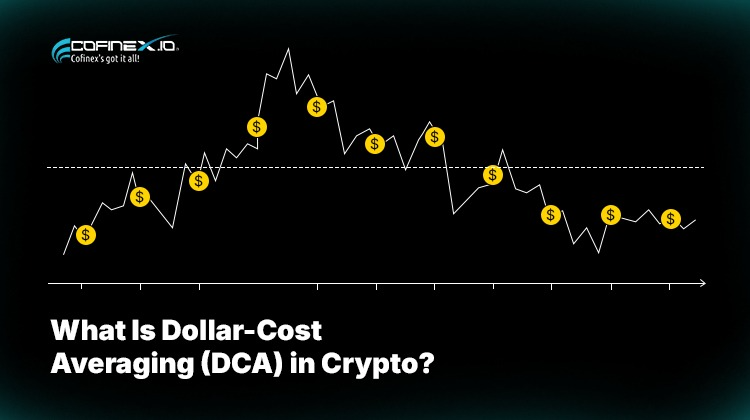
    Instead of trying to buy at the “perfect” price, DCA involves investing a fixed amount of money at regular intervals, regardless of whether the market is going up or down. This approach helps reduce emotional decision-making and encourages a consistent investing habit.

    What Is Dollar-Cost Averaging (DCA)?

    Dollar-Cost Averaging (DCA) is an investment strategy where you invest a fixed amount of money into an asset at regular intervals.

    For example, instead of investing $1,200 all at once, you might invest $100 every month for one year.

    With DCA, the amount you invest stays the same, but the number of cryptocurrency units you buy changes based on the market price.

    • When prices are lower, your fixed investment buys more cryptocurrency.
    • When prices are higher, the same investment buys fewer units.

    Over time, this approach spreads your purchases across different market conditions instead of relying on a single buying price.

    Why Do Investors Use Dollar-Cost Averaging?

    Cryptocurrency markets are known for their volatility. Prices can rise or fall significantly within a short period.

    Because of this, many investors find it difficult to decide when to invest.

    Dollar-Cost Averaging removes the pressure of trying to predict market movements. Instead of waiting for the “perfect” time, investors follow a consistent investment schedule.

    This approach can also reduce emotional decisions, such as buying during market excitement or selling during periods of fear.

    Although DCA does not eliminate investment risk, it encourages a disciplined approach to investing.

    How Does Dollar-Cost Averaging Work?

    Dollar-Cost Averaging follows a simple process.

    First, decide how much money you want to invest regularly.

    Next, choose how often you want to invest. Some people invest weekly, while others prefer monthly or quarterly investments.

    Then, continue investing the same amount regardless of the market price.

    For example, imagine you decide to invest $100 every month in Bitcoin.

    MonthBitcoin PriceAmount Invested
    JanuaryHigher$100
    FebruaryLower$100
    MarchHigher$100
    AprilLower$100

    Although the price changes each month, your investment amount remains the same.

    As a result, you buy more Bitcoin when prices are lower and less when prices are higher. Over time, this helps spread your purchases across different price levels.

    Benefits of Dollar-Cost Averaging

    Dollar-Cost Averaging offers several advantages, especially for beginners.

    Reduces Emotional Investing

    One of the biggest challenges in investing is controlling emotions.

    DCA encourages investors to follow a consistent plan instead of reacting to short-term market movements.

    Builds a Regular Investment Habit

    Investing a fixed amount regularly can help create long-term financial discipline.

    Reduces the Pressure of Market Timing

    Trying to predict the best time to invest is difficult.

    With DCA, investors focus on consistency instead of attempting to buy at the lowest possible price.

    Suitable for Volatile Markets

    Since cryptocurrency prices often fluctuate, DCA allows investors to spread their purchases over time instead of investing everything at once.

    Limitations of Dollar-Cost Averaging

    Although DCA is a popular strategy, it is not suitable for every situation.

    It is important to understand its limitations.

    • DCA does not guarantee profits.
    • It does not protect against investment losses.
    • During a consistently rising market, investing a lump sum earlier may produce better returns because more money is invested sooner.
    • Investors still need to choose suitable assets and understand the risks involved.

    For these reasons, DCA should be viewed as a strategy for managing investment timing rather than eliminating risk.

    Dollar-Cost Averaging vs Lump-Sum Investing

    Dollar-Cost AveragingLump-Sum Investing
    Invests a fixed amount regularlyInvests all available money at one time
    Reduces the need to time the marketDepends more on the market price at the time of investment
    Helps build consistent investing habitsMay benefit more during steadily rising markets
    Commonly used by beginnersOften chosen by experienced investors, depending on their strategy

    Both strategies have advantages, and neither is universally better. The most suitable approach depends on an individual’s financial goals, investment timeline, and risk tolerance.

    Is Dollar-Cost Averaging Suitable for Beginners?

    For many beginners, Dollar-Cost Averaging can be a practical way to start investing.

    It encourages consistency, reduces emotional decision-making, and removes the pressure of trying to predict short-term market movements.

    However, every investment carries risk. Before investing, take time to understand the asset you are buying and ensure it aligns with your financial goals.

    Frequently Asked Questions

    What is Dollar-Cost Averaging (DCA)?

    It is an investment strategy where you invest a fixed amount of money at regular intervals, regardless of the market price.

    Is Dollar-Cost Averaging good for beginners?

    Many beginners use DCA because it encourages consistent investing and reduces the pressure of trying to predict market movements.

    Does DCA guarantee profits?

    No. DCA is a strategy for spreading investments over time. It does not guarantee profits or protect against losses.

    Can I use DCA for Bitcoin and Ethereum?

    Yes. Many investors use it with Bitcoin, Ethereum, and other cryptocurrencies. However, it is important to research any asset before investing.

    How often should I invest using DCA?

    There is no single correct schedule. Some investors choose weekly, biweekly, or monthly investments based on their financial situation and investment plan.

    Disclaimer

    This lesson is for educational purposes only and should not be considered financial, investment, or legal advice. Dollar-Cost Averaging is an investment strategy and does not guarantee profits or prevent losses. Cryptocurrency markets are volatile, and all investments involve risk. Always conduct your own research and consider your financial goals before making investment decisions.

    Trade on the Go with the Cofinex Mobile App

    Download for Android

    Download for iOS

    Follow Cofinex

    Telegram: https://t.me/cofinexofficial

    X (Twitter): https://x.com/CofinexExchange

    Facebook: https://www.facebook.com/

    Instagram: https://www.instagram.com/cofinexexchange/

    LinkedIn: https://in.linkedin.com/company/cofinexexchange

    WhatsApp Channel: https://whatsapp.com/channel/0029VbBSQtJ2P59lfbaRXJ2k

    YouTube: https://www.youtube.com/@cofinexexchange

  • Bitcoin vs Mutual Funds – Which One to Invest in India

    Bitcoin vs Mutual Funds – Which One to Invest in India

    Introduction

    Many people who are new to investing ask the same question: Should I invest in Bitcoin or mutual funds?

    It’s a common question because both have become popular investment options over the years. However, they work in very different ways and suit different financial goals.

    Some people choose Bitcoin because they want to explore cryptocurrency and blockchain technology. Others prefer mutual funds because professional fund managers make investment decisions on their behalf.

    So, does that mean one investment is always better than the other?

    Not necessarily.

    The right choice depends on your financial goals, investment timeline, and how much risk you’re comfortable taking. That’s why understanding both investment options is more important than simply following market trends.

    In this lesson, you’ll learn how Bitcoin and mutual funds work, discover their key differences, and understand what beginners should consider before making any investment decisions.

    What is Bitcoin?

    Bitcoin is the world’s first cryptocurrency. It was introduced in 2009 by an anonymous person or group using the name Satoshi Nakamoto.

    Unlike traditional currencies such as the Indian Rupee (INR), Bitcoin exists only in digital form. Instead of relying on a bank or government, it runs on blockchain technology. This technology records every transaction across a decentralized network of computers, helping keep the network transparent and secure.

    Because no single organization controls Bitcoin, people can send and receive it directly without depending on traditional financial institutions.

    People use Bitcoin for different reasons. Some buy Bitcoin because they believe it may increase in value over time. Others use it to diversify their investment portfolios or transfer value across the world.

    If you’re just starting your cryptocurrency journey, we recommend reading our What Is Bitcoin? lesson before exploring more advanced topics.

    What is a Mutual Fund?

    A mutual fund is an investment product that combines money from many investors into one professionally managed portfolio.

    Instead of selecting individual investments yourself, you invest your money in the fund. Professional fund managers then invest that money according to the fund’s investment objective.

    Depending on the fund, they may invest in stocks, bonds, money market instruments, or a combination of different assets.

    As a result, one investment gives you exposure to several assets at the same time. This approach is known as diversification, and it helps spread investment risk across different investments.

    Many beginners choose mutual funds because professionals manage the portfolio for them. However, mutual funds still carry risk, and their value can rise or fall depending on market conditions.

    Bitcoin vs Mutual Funds: What’s the difference?

    Although Bitcoin and mutual funds are both investment options, they serve different purposes.

    BitcoinMutual Funds
    Digital cryptocurrencyProfessionally managed investment fund
    Runs on blockchain technologyInvests in stocks, bonds, or other financial assets
    Trades 24 hours a day, 7 days a weekUsually follows stock market trading hours
    Prices can change significantly within a short periodPrices generally fluctuate less because the fund holds multiple investments
    Stored in a Bitcoin Wallet or another compatible crypto walletHeld through an investment account

    Neither investment is automatically better than the other. Instead, each offers different opportunities and risks.

    Why do people invest in Bitcoin and Mutual Funds?

    People choose different investments based on their financial goals, experience, and willingness to accept risk. Therefore, understanding the potential benefits of each option can help you make more informed decisions.

    Why Do People Invest in Bitcoin?

    Bitcoin has become one of the most well-known cryptocurrencies in the world for several reasons.

    First, it operates on a decentralized blockchain network instead of relying on a central authority.

    In addition, the cryptocurrency market operates 24 hours a day, allowing people to buy or sell Bitcoin at almost any time.

    Many investors also include Bitcoin in their portfolios to diversify their investments.

    Furthermore, Bitcoin allows people to send and receive digital value across the world without depending on traditional banking systems.

    If you’re interested in cryptocurrency, you can Buy Bitcoin through a trusted Crypto Exchange or Crypto Trading Platform. You can also continue learning about Buy Ethereum, USDT Exchange, and Blockchain Technology through the Cofinex Academy.

    Why Do People Invest in Mutual Funds?

    Mutual funds remain popular because they offer a simple way to start investing.

    First, professional fund managers make investment decisions on behalf of investors.

    Next, one mutual fund provides exposure to multiple assets instead of just one investment.

    As a result, diversification may reduce the impact of poor performance from a single asset.

    In addition, many mutual funds allow people to begin investing with relatively small amounts.

    Although these benefits are attractive, every investment still carries risk. That’s why understanding the risks is just as important as understanding the potential rewards.

    What Should You Remember Before Investing?

    Every investment decision should begin with learning.

    Instead of following social media trends or investing because someone else recommends an asset, take time to understand how it works.

    The more knowledge you build today, the more confident you’ll become when making financial decisions in the future.

    That’s also why the Cofinex Academy offers beginner-friendly lessons on Bitcoin, Ethereum, Blockchain Technology, USDT, and Crypto Trading. Learning these topics first will help you build a stronger foundation before investing.

    Understanding the Risks

    Every investment involves some level of risk. Therefore, it’s important to understand the risks before investing your money.

    Risks of Bitcoin

    Bitcoin is known for its price volatility. Its value can increase or decrease significantly within a short period. Because of this, investors should be prepared for market fluctuations.

    Security is another important factor. Although the Bitcoin network is highly secure, users must protect their own digital assets. Using a secure Bitcoin Wallet, enabling two-factor authentication (2FA), and keeping recovery phrases private can help reduce security risks.

    In addition, cryptocurrency regulations continue to evolve. Before you Buy Bitcoin, always understand the latest rules that apply in your country.

    Risks of Mutual Funds

    Mutual funds are generally less volatile than cryptocurrencies, but they are not risk-free.

    Their value depends on the performance of the assets they hold. If financial markets decline, the value of a mutual fund may also decrease.

    Similarly, professional fund managers cannot guarantee profits. Every investment carries some level of market risk, regardless of who manages it.

    Understanding these risks can help you make more informed investment decisions.

    Which investment might suit you?

    Many beginners ask, “Which investment is better?”

    The answer depends on your financial goals, investment horizon, and risk tolerance.

    For example, some investors prefer mutual funds because professionals manage the portfolio and diversification helps spread investment risk.

    On the other hand, some people choose Bitcoin because they want exposure to blockchain technology and digital assets.

    Some investors include both traditional investments and cryptocurrencies in their portfolios. However, every financial decision should be based on your personal goals rather than market trends or social media opinions.

    Before investing, take time to understand how each investment works. The more knowledge you gain, the more confident you’ll become when making financial decisions.

    Final Thoughts

    Bitcoin and mutual funds are different investment options, and each serves a different purpose.

    Bitcoin introduced a new way to own and transfer digital assets through blockchain technology. In contrast, mutual funds provide access to professionally managed investment portfolios that may include stocks, bonds, or other financial assets.

    Instead of choosing an investment because it’s popular, focus on understanding how it works. Every investor has different financial goals, so there isn’t a single investment that’s right for everyone.

    The more you learn today, the better prepared you’ll be to make informed financial decisions in the future.

    Frequently Asked Questions

    Is Bitcoin better than mutual funds?

    Neither investment is automatically better. The right choice depends on your financial goals, investment timeline, and willingness to accept risk.

    Can I invest in both Bitcoin and mutual funds?

    Yes. Some investors choose to diversify by investing in different asset classes. However, every investment decision should match your personal financial goals.

    Can I Buy Bitcoin through Cofinex?

    Yes. You can Buy Bitcoin through Spot Trading on Cofinex and securely store it in your Bitcoin Wallet.

    Can I Buy Ethereum on Cofinex?

    Yes. Cofinex also allows users to Buy Ethereum and trade other supported cryptocurrencies through its secure Crypto Trading Platform.

    Where can I learn more about cryptocurrency?

    The Cofinex Academy offers beginner-friendly lessons on Bitcoin, Ethereum, USDT, Blockchain Technology, Crypto Wallets, and Spot Trading to help you build a strong foundation.

    Disclaimer

    This lesson is for educational purposes only and should not be considered financial, investment, or legal advice. Cryptocurrency and mutual fund investments involve risk. Always do your own research before making investment decisions.