Category: Ethereum

  • Ethereum Institutional Demand: What Investors Should Know

    Ethereum Institutional Demand: What Investors Should Know

    Ethereum is attracting attention for more than its cryptocurrency, ETH. Banks, asset managers, and financial service providers are exploring how its blockchain can support tokenized assets, digital payments, and financial settlement.

    This shift is important because blockchain technology can do more than transfer cryptocurrency. It can also help institutions issue digital representations of traditional investments and move value through compatible financial applications.

    Recent developments show that institutional interest is moving beyond experiments. However, greater blockchain adoption does not automatically mean higher ETH prices or better investment returns.

    Why Are Institutions Exploring Ethereum?

    Ethereum is a blockchain network that supports smart contracts, digital assets, and decentralised applications. These features allow developers and financial institutions to build services that operate through blockchain-based systems.

    Financial firms are exploring Ethereum for several reasons.

    1. Tokenized Financial Assets

    Tokenization involves representing ownership rights or interests in assets through digital tokens on a blockchain.

    For example, an asset manager can create tokenized shares in a money market fund. Eligible investors can then hold or transfer those digital representations through supported systems, subject to the fund’s terms and regulatory requirements.

    Institutions are exploring tokenization for money market funds, bonds, private credit, and other financial products.

    Ethereum and its Layer 2 networks provide infrastructure for some of these products. Ethereum’s official enterprise resources highlight tokenized assets, programmable payments, and onchain settlement as important institutional use cases

    2. Faster and More Flexible Settlement

    Traditional financial transactions often depend on several intermediaries, operating schedules, and separate record-keeping systems.

    Blockchain-based settlement can help compatible parties transfer digital assets and value around the clock. Smart contracts can also automate certain steps when transactions meet predefined conditions.

    For institutions, these features may simplify specific payment, collateral, and settlement processes. However, blockchain transactions still depend on network conditions, application design, legal arrangements, and the systems connecting them to traditional finance.

    3. Digital Money for Onchain Transactions

    Tokenized investments need ways to move money alongside the assets themselves.

    Some institutions are therefore exploring stablecoins and bank deposit tokens as digital payment options for onchain transactions.

    For example, JPMorgan expanded its JPM Coin deposit token to Ethereum in October 2026, allowing eligible institutional clients to transfer dollar-denominated bank deposit tokens through the network as well as Base.

    This development illustrates how Ethereum can support both tokenized financial assets and the movement of money used in digital financial transactions.

    What Is Driving Institutional Interest in Ethereum?

    Institutional adoption does not come from a single factor. Several features make Ethereum relevant to financial firms.

    Established infrastructure: Ethereum supports smart contracts, wallets, digital assets, and applications that institutions can integrate into selected financial workflows.

    Public verification: Blockchain records can allow participants to verify transactions and asset movements, although privacy and confidentiality still require careful design.

    Connected applications: Compatible applications can interact with digital assets and smart contracts, potentially creating more flexible financial services.

    Layer 2 networks: These networks build on Ethereum to support transactions with different cost and performance characteristics while using Ethereum as part of their security or settlement architecture.

    Even so, institutions do not automatically choose Ethereum for every project. They assess cost, performance, privacy, regulatory requirements, interoperability, and operational risks before selecting infrastructure.

    Does Institutional Demand Increase ETH’s Value?

    This is an important distinction for crypto investors.

    Institutional use of Ethereum and investment demand for ETH are related, but they are not the same thing.

    ETH is Ethereum’s native cryptocurrency. The network uses ETH to pay gas fees for transactions and smart contract operations on its mainnet. ETH also plays a role in staking, which helps secure the proof-of-stake network.

    As activity grows, users may need ETH to pay certain network fees. However, the relationship between network activity and ETH’s market price is not straightforward.

    Here are three reasons why.

    Network Usage Does Not Equal Investment Returns

    More tokenized assets or financial applications on Ethereum may increase network activity, but this does not guarantee that ETH’s price will rise.

    Transaction fees vary with network demand. In addition, many users interact with Ethereum through Layer 2 networks, where fee structures and the amount of ETH used for settlement can differ.

    Institutions May Use Ethereum Without Buying ETH as an Investment

    A financial institution might use Ethereum infrastructure to issue a tokenized fund or transfer a deposit token. That activity does not necessarily mean the institution is buying ETH to hold as an investment.

    The institution’s direct exposure depends on how it designs and operates the product.

    Market Prices Depend on Multiple Factors

    ETH’s market price also responds to broader crypto sentiment, investor positioning, liquidity, economic conditions, supply dynamics, and competition from other networks.

    Institutional adoption may influence expectations about Ethereum’s future utility, but investors should not treat adoption announcements as reliable price predictions.

    What Should Investors Watch?

    Anyone following Ethereum’s institutional adoption can monitor several indicators to understand how the ecosystem is developing.

    • Tokenized asset growth: Track the value and variety of financial assets issued on Ethereum and its Layer 2 networks.
    • Stablecoin activity: Examine stablecoin supply and transfer activity to understand how people and institutions use the network for digital payments.
    • Live institutional deployments: Distinguish between announced partnerships, pilot projects, and products that clients can actually use.
    • Network activity and fees: Monitor transaction activity, fee demand, and how activity is distributed between Ethereum mainnet and Layer 2 networks.
    • ETH market data: Review price trends, liquidity, trading volume, and broader market conditions separately from adoption metrics.

    These indicators measure different things. Tokenized asset value reflects the assets represented onchain, while transaction activity measures network use. Neither metric alone explains the future price of ETH.

    What Risks Should Institutions Consider?

    Blockchain infrastructure can offer new capabilities, but institutions must also assess its risks.

    Smart contract vulnerabilities can affect applications and digital assets. Network congestion may increase transaction costs, while outages or operational failures in connected services can disrupt access.

    Financial products also carry their own risks. A tokenized fund remains exposed to its underlying investments, and tokenization does not automatically remove liquidity constraints or legal restrictions.

    Regulation, custody, cybersecurity, privacy, and interoperability remain important considerations. Institutions need to understand both the blockchain and the financial product before adopting the technology.

    Final Thoughts

    Ethereum’s role in institutional finance is expanding as financial firms explore tokenized investments, digital payments, and blockchain-based settlement.

    These developments demonstrate how blockchain infrastructure can support financial activities beyond conventional cryptocurrency trading. However, institutional adoption, network usage, and ETH investment performance remain separate measures.

    For investors, the useful approach is to follow actual deployments, network activity, and market conditions rather than assume every adoption announcement will increase ETH’s price.

    As tokenization develops, Ethereum’s long-term role will depend on real usage, reliable infrastructure, regulatory clarity, and the value its applications provide to institutions and users.

    This article is for educational purposes only and does not constitute financial or investment advice.

    Follow Cofinex

    Telegram: https://t.me/cofinexofficial

    X (Twitter): https://x.com/CofinexExchange

    Facebook: https://www.facebook.com/

    Instagram: https://www.instagram.com/cofinexexchange/

    LinkedIn: https://in.linkedin.com/company/cofinexexchange

    WhatsApp Channel: https://whatsapp.com/channel/0029VbBSQtJ2P59lfbaRXJ2k
    YouTube: https://www.youtube.com/@cofinexexchange

  • Solana vs Ethereum: What are the key differences?

    Solana vs Ethereum: What are the key differences?

    Solana and Ethereum are two well-known blockchain networks in the cryptocurrency ecosystem. Both support decentralised applications, smart contracts, and digital assets. However, they use different approaches to process transactions, maintain network security, and support developers.

    While Ethereum is known for its established smart contract ecosystem, Solana focuses on high transaction throughput and low transaction costs.

    So, what makes these two blockchains different? And how should beginners understand their strengths, limitations, and use cases?

    In this lesson, we will compare Solana and Ethereum across their technology, consensus mechanisms, transaction fees, scalability, ecosystems, and security.

    1. What is Ethereum?

    Ethereum is a decentralised, open-source blockchain platform that allows developers to build and run smart contracts and decentralised applications (dApps).

    Its native cryptocurrency is Ether (ETH), which users need to pay transaction fees and interact with applications on the network.

    Ethereum supports several types of blockchain-based services, including:

    • Decentralised finance (DeFi)
    • Non-fungible tokens (NFTs)
    • Decentralised exchanges
    • Blockchain gaming
    • Decentralised autonomous organisations (DAOs)
    • Token creation and management

    Ethereum uses a Proof of Stake (PoS) consensus mechanism. Validators stake ETH to participate in network security and transaction validation.

    In addition, Ethereum supports Layer 2 networks, which process transactions outside the main network and use Ethereum for settlement and security-related functions, depending on their design.

    2. What is Solana?

    Solana is a decentralised blockchain designed to support fast transactions and scalable applications.

    Its native cryptocurrency is Solana (SOL), which users can use to pay transaction fees, participate in staking, and interact with applications on the network.

    Solana supports various blockchain applications, including:

    • Decentralised finance
    • NFT marketplaces
    • Blockchain gaming
    • Token creation
    • Decentralised exchanges
    • Payment applications

    Solana uses Proof of Stake alongside a mechanism called Proof of History (PoH).

    Proof of History helps establish an ordered record of events using cryptographic timestamps. It works alongside Solana’s consensus system rather than replacing Proof of Stake.

    Solana’s architecture aims to process transactions quickly while keeping costs relatively low.

    3. Solana vs Ethereum: Key differences

    Although both networks support smart contracts and decentralised applications, their technical designs differ.

    FeatureEthereumSolana
    Native cryptocurrencyETHSOL
    Consensus mechanismProof of StakeProof of Stake with Proof of History
    Smart contractsSupportedSupported
    Transaction processingMainnet and Layer 2 scaling ecosystemDesigned for high throughput on its base layer
    Transaction feesCan vary with network demandGenerally low, but can vary
    Scaling approachLayer 2 rollups and protocol improvementsHigh-throughput base-layer architecture
    Programming languagesSolidity, Vyper and othersRust and other supported languages
    StakingETH stakingSOL staking
    EcosystemDeFi, NFTs, DAOs and infrastructureDeFi, NFTs, payments and consumer applications

    These differences show that both networks follow different approaches to blockchain development. However, neither network is automatically better for every application.

    4. Consensus mechanism: Proof of Stake vs Proof of History

    One of the main differences between Ethereum and Solana is how they organise and process blockchain activity.

    Ethereum: Proof of Stake

    Ethereum uses Proof of Stake to secure its network.

    Validators stake ETH and participate in proposing and attesting to blocks. The protocol selects validators to perform these responsibilities.

    Validators that follow the protocol can earn rewards. However, they may face penalties for certain failures or harmful actions.

    Ethereum introduced Proof of Stake in September 2022 through an upgrade known as The Merge.

    Solana: Proof of Stake and Proof of History

    Solana combines Proof of Stake with Proof of History.

    Proof of History creates a verifiable sequence of events using cryptographic hashing. This helps the network establish the order of transactions and coordinate activity.

    Proof of Stake supports validator participation and network security.

    In simple terms, Proof of History helps Solana organise events, while Proof of Stake contributes to its consensus and security model.

    However, Proof of History is not a replacement for consensus. Both mechanisms work together within Solana’s architecture.

    5. Transaction speed and fees

    Transaction speed and cost are important factors when choosing a blockchain application.

    Ethereum’s main network can experience higher fees when demand increases. During busy periods, users may need to pay more to get their transactions processed.

    Layer 2 networks help address this issue by processing transactions separately and using Ethereum for settlement.

    Solana is designed to process a high volume of transactions directly on its base layer. As a result, it generally offers low transaction fees and fast transaction processing.

    However, actual performance depends on network conditions, transaction complexity, congestion, and application design.

    Also, advertised transaction throughput is not the same as the number of successful user transactions a network consistently processes under real-world conditions.

    6. Scalability: How do the networks handle growth?

    Scalability refers to a blockchain’s ability to handle increasing transaction activity without significantly affecting performance, cost, or user experience.

    Ethereum follows a scaling approach that includes Layer 2 rollups.

    These networks process transactions outside Ethereum’s main execution layer and submit data and proofs to Ethereum according to their designs.

    Examples include Arbitrum, Optimism, and other rollup networks.

    Solana takes a different approach. Its base-layer architecture aims to support high transaction throughput without relying on a separate rollup ecosystem for its primary scaling strategy.

    Both approaches have trade-offs.

    Ethereum’s Layer 2 ecosystem offers different scaling environments, but users may need to consider bridges, network compatibility, and different fee structures.

    Solana offers a more unified base-layer experience in many applications, but its architecture places significant demands on validator hardware and network infrastructure.

    7. Security and decentralisation

    Security and decentralisation are essential when evaluating any blockchain.

    Ethereum has a large validator ecosystem and an established network of developers, applications, and infrastructure providers.

    Its Proof of Stake system requires validators to stake ETH and follow protocol rules. Certain serious violations can result in slashing penalties.

    Solana also uses a validator-based Proof of Stake system. Its network depends on validators and supporting infrastructure to process transactions and maintain consensus.

    However, the two networks have different hardware requirements, validator economics, client implementations, and operational characteristics.

    When evaluating decentralisation, consider more than the number of validators. Factors such as stake distribution, client diversity, infrastructure concentration, and the ability to participate also matter.

    Neither network is completely free from technical risks, outages, or security vulnerabilities.

    8. Ecosystem and real-world use cases

    Both Ethereum and Solana support a growing range of blockchain applications.

    Ethereum ecosystem

    Ethereum has an established ecosystem with applications across several sectors.

    Common use cases include:

    • DeFi lending and borrowing
    • Decentralised exchanges
    • NFT marketplaces
    • Stablecoins and tokenised assets
    • DAOs and governance
    • Layer 2 applications

    Ethereum also has a large developer community and extensive development tools.

    Solana ecosystem

    Solana supports applications that often benefit from fast transaction processing and relatively low fees.

    Common use cases include:

    • Decentralised exchanges
    • DeFi applications
    • NFT platforms
    • Blockchain games
    • Payments
    • Consumer-focused applications

    Its low transaction costs can make frequent on-chain interactions more accessible.

    However, the quality, security, and adoption of individual applications vary across both ecosystems.

    9. ETH vs SOL: Understanding their native tokens

    ETH and SOL are the native cryptocurrencies of their respective networks. Both play important roles in network operations, but their supply and fee mechanisms differ.

    ETH:

    • Used to pay Ethereum transaction fees.
    • Used for staking and validator participation.
    • Has no fixed maximum supply under its current protocol rules.
    • A portion of transaction base fees is burned under EIP-1559.

    SOL:

    • Used to pay Solana transaction fees.
    • Used for staking and validator participation.
    • Has an inflationary issuance model, with a schedule that reduces the inflation rate over time.
    • Solana burns a portion of certain transaction fees under its fee rules.

    Neither token’s price is determined by its technology alone. Market demand, supply, adoption, investor sentiment, and broader economic conditions can all influence its value.

    10. Solana vs Ethereum: Which one should you choose?

    There is no single answer because both networks serve different needs.

    Ethereum may be relevant if you are interested in:

    • Exploring established DeFi applications.
    • Using Ethereum-based tokens and smart contracts.
    • Accessing its Layer 2 ecosystem.
    • Learning about blockchain infrastructure and decentralised governance.

    Solana may be relevant if you are interested in:

    • Applications designed for fast transaction processing.
    • Lower-cost on-chain interactions.
    • Exploring Solana-based DeFi and consumer applications.
    • Understanding alternative blockchain architectures.

    Before using either network, consider transaction fees, wallet compatibility, application security, network conditions, and the risks associated with individual projects.

    Most importantly, choosing a blockchain for an application is different from choosing its native cryptocurrency as an investment.

    Final thoughts

    Ethereum and Solana are two important blockchain ecosystems, but they take different approaches to scalability, transaction processing, and network design.

    Ethereum combines Proof of Stake with a broad Layer 2 ecosystem, while Solana uses Proof of Stake alongside Proof of History to support high-throughput activity on its base layer.

    Both networks have strengths, limitations, and risks. Therefore, understanding their differences can help you make better decisions when exploring blockchain applications.

    Remember, a faster network or lower transaction fee does not automatically make a blockchain a better investment. Always research the technology, ecosystem, security, and risks before using a network or investing in its native token.

    Frequently asked questions

    1. Is Solana faster than Ethereum?

    Solana is designed for higher transaction throughput on its base layer and generally offers faster, lower-cost transactions. Ethereum’s main network has different performance characteristics, while its Layer 2 ecosystem provides additional scaling options.

    2. Does Solana use Proof of Stake?

    Yes. Solana uses Proof of Stake alongside Proof of History. Proof of History helps establish the order of events, while Proof of Stake supports validator participation and consensus.

    3. Is Ethereum more decentralised than Solana?

    Both networks use decentralised validator systems, but their decentralisation characteristics differ. Validator distribution, stake concentration, hardware requirements, client diversity, and infrastructure dependencies are important factors to examine.

    4. What is the difference between ETH and SOL?

    ETH is Ethereum’s native cryptocurrency, while SOL is Solana’s native cryptocurrency. Both are used for transaction fees and staking, but their supply mechanisms and network fee rules differ.

    5. Can Ethereum and Solana support smart contracts?

    Yes. Both networks support smart contracts and decentralised applications. However, they use different development environments, programming tools, and execution models.

    6. Which blockchain is better for beginners?

    It depends on what you want to explore. Ethereum offers a broad ecosystem and extensive learning resources, while Solana provides an environment with relatively low transaction costs. Beginners should start by understanding wallet security, transaction fees, and application risks on either network.

    Disclaimer

    This article is intended for educational and informational purposes only. It does not constitute financial, investment, or technical advice. Cryptocurrencies and blockchain applications involve risks, including market volatility, technical failures, smart contract vulnerabilities, and loss of funds. Always conduct independent research and understand the risks before using a blockchain network or investing in its native cryptocurrency.

  • How do smart contract upgrades work and why do they matter?

    How do smart contract upgrades work and why do they matter?

    Smart contracts are an important part of blockchain technology. They power decentralised applications, token transfers, lending platforms, NFT marketplaces, and many other blockchain-based services.

    However, what happens when a smart contract contains a bug, needs a security improvement, or requires a new feature?

    Unlike traditional software, smart contracts often run on blockchains where deployed code cannot simply be edited like a regular application. Therefore, developers need specific methods to update or replace smart contracts.

    This process is known as a smart contract upgrade.

    In this lesson, we will explore how smart contract upgrades work, why projects need them, and what risks users should understand before interacting with upgradeable contracts.

    1. What is a smart contract?

    A smart contract is a programme deployed on a blockchain that executes instructions when predefined conditions are met.

    For example, imagine a decentralised lending application. A smart contract can manage deposits, calculate interest according to its programmed rules, and process eligible withdrawals.

    Once deployed, the contract operates according to its code and the rules of the blockchain.

    However, developers may discover problems or identify opportunities to improve the contract after deployment. In such cases, an upgrade may become necessary.

    2. What is a smart contract upgrade?

    A smart contract upgrade is a process used to change or improve the functionality of an existing blockchain application.

    An upgrade may introduce new features, fix vulnerabilities, improve performance, or modify existing rules.

    For example, suppose a decentralised application has a smart contract that supports token deposits and withdrawals. Later, developers identify a security weakness in its withdrawal process.

    They may introduce an updated contract that addresses the issue.

    However, the method used to upgrade a contract depends on how developers designed it before deployment.

    Importantly, not every smart contract can be upgraded directly. Some contracts are designed to remain unchanged after deployment.

    3. Why do smart contracts need upgrades?

    Although developers test smart contracts before deployment, no software is completely free from errors or vulnerabilities.

    Here are some common reasons why projects upgrade their contracts.

    Security improvements

    Security is one of the main reasons for contract upgrades.

    Developers may discover vulnerabilities that could allow unauthorised access, incorrect transactions, or loss of funds. Therefore, they may need to introduce changes to reduce these risks.

    However, an upgrade cannot guarantee complete security. The updated code must also undergo careful testing and review.

    Bug fixes

    Sometimes, a contract may contain programming errors that affect how it performs certain operations.

    For example, a calculation error could cause a reward distribution mechanism to work incorrectly.

    Developers may release an updated implementation to correct the issue.

    Adding new features

    Blockchain applications evolve over time. As a result, developers may introduce new features to improve the user experience or support additional services.

    For instance, a decentralised finance application may update its contract to support another token or introduce a new lending feature.

    Improving efficiency

    Developers may also upgrade contracts to improve how they use blockchain resources.

    For example, changes may reduce unnecessary operations or make certain processes more efficient. However, any proposed change must still follow the rules of the blockchain.

    Adapting to changing requirements

    A project may need to change its contract logic as its ecosystem grows.

    For example, developers may update governance rules, introduce new reward mechanisms, or modify certain parameters to support the application’s development.

    4. How do smart contract upgrades work?

    There are different ways to upgrade smart contracts. The approach depends on the contract’s original design.

    Let’s understand three common methods.

    Method 1: Deploying a new contract

    One straightforward method is to deploy a completely new smart contract.

    Developers create an updated version, test it, and deploy it to the blockchain.

    After deployment, the project may ask users to interact with the new contract instead of the old one.

    For example, a token project may deploy a new contract to introduce improved functionality. Depending on the design, users may need to transfer or migrate their tokens to the new contract.

    However, this method can create additional work for users and developers. The old contract may also remain on the blockchain, even after the project stops using it.

    Method 2: Proxy contracts

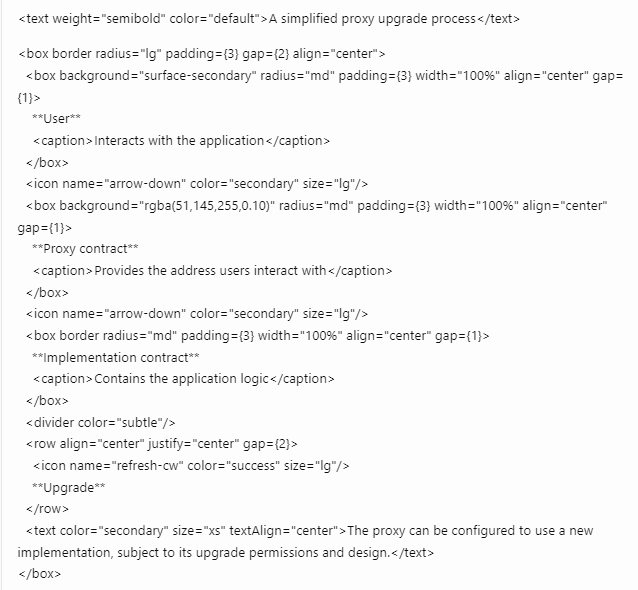
    A proxy contract is a common method for creating upgradeable smart contracts.

    In this arrangement, users interact with a proxy contract, which delegates execution to another contract called the implementation contract.

    The proxy generally maintains the relevant storage, while the implementation contract contains the logic used to execute operations.

    When developers upgrade the application, they can change which implementation the proxy points to.

    This allows the application to use updated logic while retaining the proxy address and, when correctly designed, its existing state.

    Although proxy contracts make upgrades easier, they introduce additional considerations. For example, incorrect storage layouts or poorly controlled upgrade permissions can create serious security problems.

    Method 3: Diamond pattern

    The Diamond pattern is another approach to building upgradeable smart contracts.

    Instead of relying on one large implementation contract, it divides functionality into smaller modules called facets.

    Each facet handles specific functions. A central diamond contract routes user requests to the relevant facet.

    Developers can add, replace, or remove certain facets without replacing the entire application structure.

    This approach can be useful for complex applications. However, it also introduces additional design and security considerations.

    5. Who controls smart contract upgrades?

    One important question is: who has permission to change a smart contract?

    The answer depends on the project’s governance and contract design.

    Some projects allow a development team or administrator to approve upgrades. Others use multisignature wallets, decentralised governance, or time-lock mechanisms.

    Here are some common arrangements:

    • Admin-controlled upgrades: A designated administrator can approve or execute contract changes.
    • Multisignature approval: Multiple authorised signers must approve an upgrade before it can proceed.
    • DAO governance: Token holders or designated governance participants vote on proposed changes, according to the project’s rules.
    • Timelock mechanism: An approved upgrade must wait for a specified period before execution.

    These arrangements can improve accountability, but they do not automatically make a contract safe.

    For example, if one administrator has unrestricted upgrade permissions, that person or compromised account may be able to change the contract’s behaviour.

    Therefore, always check who controls the upgrade mechanism.

    6. What are the risks of smart contract upgrades?

    Upgradeable contracts offer flexibility, but they also introduce risks that users should understand.

    Centralisation risk

    If only one person or organisation controls upgrades, users must trust that authority to act responsibly.

    A compromised administrator account could potentially approve harmful changes.

    Malicious upgrades

    An authorised upgrade mechanism could be misused to introduce harmful code.

    Depending on the contract’s permissions and design, this could affect user balances, withdrawals, or other application functions.

    Storage compatibility problems

    Upgradeable contracts must handle stored data carefully.

    For example, a poorly designed implementation update may change how the contract reads or writes existing data. This can lead to unexpected behaviour or application failures.

    New vulnerabilities

    An upgrade intended to improve security may introduce new bugs.

    Therefore, developers should test updated code and arrange appropriate security reviews before implementation.

    Governance risks

    If upgrades depend on community voting, low participation or concentrated voting power may affect decisions.

    As a result, governance processes should be transparent and clearly documented.

    User confusion

    Some upgrades require users to migrate tokens, approve new contracts, or take other actions.

    Without clear communication, users may interact with outdated contracts or fall victim to fake upgrade announcements.

    Always verify upgrade instructions through official project channels.

    7. How can users check whether a smart contract is upgradeable?

    You do not need to be a blockchain developer to perform basic checks.

    However, you should know where to look.

    Here are some useful steps:

    1. Check the contract address: Find the official address through the project’s verified website or documentation.
    2. Use a blockchain explorer: Open the contract on an explorer such as Etherscan.
    3. Review the contract information: Look for verified source code and proxy indicators, where available.
    4. Check upgrade permissions: Examine whether an administrator, multisignature wallet, or governance mechanism controls upgrades.
    5. Review upgrade history: Check whether the implementation address or contract logic has changed.
    6. Read official announcements: Verify whether the project has explained the reason and impact of an upgrade.

    A blockchain explorer can help you inspect contract activity and verified code. However, interpreting proxy permissions and implementation details may require technical knowledge.

    8. Upgradeable vs immutable smart contracts

    Not every project chooses to make its smart contracts upgradeable.

    Some contracts are designed to remain immutable, meaning their deployed code cannot be changed through an administrative upgrade mechanism.

    Upgradeable contractsImmutable contracts
    Can support changes through an upgrade mechanismDeployed code cannot be directly changed
    Allow developers to fix bugs or add features through upgradesChanges generally require deploying a new contract
    May depend on administrators or governanceAvoid certain upgrade-control risks
    Require users to consider upgrade permissionsStill carry risks from original code and design

    Neither approach is automatically better in every situation.

    Upgradeable contracts offer flexibility, while immutable contracts provide stronger guarantees that their deployed logic will not be changed through an upgrade mechanism.

    However, immutability does not guarantee that a contract is secure or free from bugs.

    Final thoughts

    Smart contract upgrades help blockchain applications adapt, improve security, fix bugs, and introduce new features.

    At the same time, they create important questions about permissions, governance, storage compatibility, and user protection.

    Before interacting with an upgradeable contract, understand who controls it, how upgrades are approved, and whether the project communicates changes transparently.

    Most importantly, remember that an upgradeable contract is not automatically unsafe, and an immutable contract is not automatically secure. The quality of the code, security practices, and governance structure all matter.

    Frequently asked questions

    1. Can smart contracts be changed after deployment?

    Some smart contracts can be upgraded through mechanisms such as proxy contracts. However, contracts without an upgrade mechanism generally cannot have their deployed code directly modified.

    2. What is a proxy contract in blockchain?

    A proxy contract is a contract that allows users to interact with an application while delegating execution to a separate implementation contract. Developers can update the implementation without necessarily changing the proxy address.

    3. Are upgradeable smart contracts safe?

    Upgradeable contracts can be useful, but their safety depends on code quality, testing, upgrade permissions, governance, and security practices. Poorly controlled upgrade mechanisms can create additional risks.

    4. What is an immutable smart contract?

    An immutable smart contract is designed so that its deployed code cannot be directly changed through an upgrade mechanism. If developers need different functionality, they generally deploy another contract.

    5. Who can approve a smart contract upgrade?

    Depending on the design, upgrades may be controlled by an administrator, a multisignature wallet, a DAO governance process, or another authorised mechanism.

    6. Does a smart contract audit guarantee that an upgrade is safe?

    No. An audit reviews code within a defined scope, but it cannot guarantee complete security. Updated implementations should also undergo appropriate testing and security reviews.

    Disclaimer

    This article is intended for educational and informational purposes only. It does not constitute financial, investment, legal, or technical advice. Smart contract upgrades involve potential security, governance, and operational risks. Always verify contract addresses, review official documentation, and conduct independent research before interacting with blockchain applications.

  • What are the risks of staking Ethereum?

    What are the risks of staking Ethereum?

    Ethereum staking allows ETH holders to participate in securing the Ethereum network and earn rewards in return. It is often described as a way to put ETH to work without actively trading it.

    However, staking is not completely risk-free. Your ETH may face market volatility, withdrawal delays, validator penalties, technical problems, or risks linked to third-party staking services.

    So, before staking Ethereum, it is important to understand how the process works and what could go wrong.

    In this lesson, we will explore the major risks of Ethereum staking, explain different staking methods, and discuss what users should consider before committing their ETH.

    What is Ethereum staking?

    Ethereum uses a Proof of Stake (PoS) consensus mechanism. Instead of relying on miners to validate transactions, the network uses validators to help propose and verify blocks.

    To become a solo validator, a participant must deposit 32 ETH into the official staking deposit contract and operate validator software.

    Validators help secure the network. In return, they can receive rewards for performing their duties correctly.

    However, not everyone needs 32 ETH to participate in staking. Users can also explore pooled staking services, staking providers, or exchange-based staking options, depending on availability.

    Although these methods make staking more accessible, each comes with its own risks and conditions.

    1. Price volatility risk

    One of the biggest risks of Ethereum staking is the changing market price of ETH.

    Staking rewards do not protect your investment from market losses.

    For example, imagine you stake 1 ETH when its market price is ₹3,00,000. Later, you earn 0.03 ETH in rewards.

    Your total balance becomes 1.03 ETH. However, if ETH falls to ₹2,50,000, the value of your holdings becomes:

    1.03 × ₹2,50,000 = ₹2,57,500.

    Although you earned additional ETH, the overall market value is still lower than your original ₹3,00,000.

    Therefore, staking rewards and investment returns are not the same thing. The value of ETH can rise or fall independently of the rewards you receive.

    2. Lock-up and withdrawal delays

    Ethereum staking does not always provide instant access to your ETH.

    When you stake ETH, your funds become part of the network’s validator system. To withdraw them, you must follow Ethereum’s withdrawal process.

    For solo validators, exiting involves entering the validator exit queue. After that, the withdrawal process must complete before the ETH becomes available.

    The waiting period can change depending on network conditions and the number of validators trying to exit.

    This creates a liquidity risk. For example, if you suddenly need money during a market decline, you may not be able to access your staked ETH immediately.

    Some liquid staking services provide tokens that represent staked ETH. These tokens may offer additional flexibility, but they can trade below or above the value of ETH and may not always be easy to sell.

    3. Slashing risk

    Slashing is a penalty that Ethereum can apply to validators for certain serious protocol violations.

    It helps protect the network from harmful validator behaviour.

    For example, validators may face slashing if they:

    • Sign conflicting blocks for the same slot.
    • Make conflicting attestations that violate protocol rules.
    • Operate validator setups that cause certain slashable actions.

    Slashing can result in the loss of a portion of the validator’s staked ETH. In serious cases, the validator may also be forced to exit.

    This risk is particularly important for solo stakers and staking operators.

    However, ordinary temporary downtime does not automatically result in slashing. It generally leads to missed rewards or smaller inactivity penalties instead.

    4. Validator downtime and technical risks

    Ethereum validators need reliable software, hardware, and internet connectivity to perform their duties.

    If a validator goes offline or fails to perform its responsibilities, it may miss rewards. Extended inactivity can also lead to penalties.

    Common causes include:

    • Internet connection problems.
    • Power failures.
    • Hardware breakdowns.
    • Software bugs.
    • Incorrect validator configuration.
    • Security issues or unauthorised access.

    For solo stakers, operating a validator requires ongoing maintenance and monitoring.

    Staking through a provider may reduce the technical workload. However, it introduces dependence on that provider’s systems and operational practices.

    5. Third-party and exchange staking risks

    Many users choose staking providers or cryptocurrency exchanges because they do not want to operate their own validators.

    Although this can make staking easier, it introduces additional risks.

    For example:

    • Custody risk: A provider may control the private keys or custody of your ETH.
    • Platform risk: Technical failures or operational problems may interrupt staking services.
    • Security risk: A platform may become a target for hacking or unauthorised access.
    • Withdrawal risk: The provider may impose its own withdrawal procedures or delays.
    • Counterparty risk: The service may become insolvent or fail to meet its obligations.

    Before choosing a provider, review its terms, custody arrangements, fees, security practices, and withdrawal policies.

    Remember, using a popular platform does not eliminate these risks.

    6. Liquid staking and depegging risk

    Liquid staking allows users to stake ETH and receive a separate token representing their staked position.

    For example, a liquid staking protocol may issue a token that represents a claim on staked ETH and associated rewards, subject to the protocol’s rules.

    These tokens can often be transferred or used in decentralised finance applications.

    However, liquid staking introduces additional risks.

    Depegging risk: A liquid staking token may trade below the value of ETH. This can happen because of market conditions, liquidity problems, or concerns about the protocol.

    Smart contract risk: Bugs or vulnerabilities in the protocol’s smart contracts may put deposited assets at risk.

    Liquidity risk: You may not find enough buyers when you want to sell your liquid staking tokens.

    Protocol risk: Changes in governance, validator operations, or the protocol’s design may affect your position.

    Therefore, liquid staking can provide flexibility, but it does not guarantee that you can always exchange the token for ETH at the expected value.

    7. Regulatory and tax uncertainty

    Staking may also involve regulatory and tax considerations.

    The treatment of staking rewards can differ between countries and may depend on the method used, the nature of the activity, and local tax rules.

    For Indian users, it is important to understand the applicable tax treatment of virtual digital assets (VDAs), including how staking-related income and later transfers may be treated.

    Do not assume that staking rewards are automatically tax-free or that every staking arrangement receives identical treatment.

    Keep records of deposits, withdrawals, rewards, transaction dates, and relevant values. If necessary, consult a qualified tax professional familiar with cryptocurrency regulations in your jurisdiction.

    8. Smart contract and network risks

    Ethereum itself is a decentralised network, but staking services and protocols may rely on additional software and smart contracts.

    These systems can contain vulnerabilities.

    For example, a bug in a staking protocol could affect deposits, withdrawals, reward distribution, or liquid staking tokens.

    In addition, network upgrades or unexpected technical issues may affect how certain services operate.

    Even when a protocol has undergone a security audit, that does not guarantee complete protection. Audits have a defined scope and cannot eliminate every possible vulnerability.

    Solo staking vs pooled staking vs exchange staking

    There are different ways to participate in Ethereum staking. Understanding their differences can help you evaluate the risks.

    Staking methodHow it worksKey risks
    Solo stakingYou operate your own validator with 32 ETHTechnical failures, downtime, slashing, maintenance
    Pooled stakingYou combine funds with other participants through a staking service or protocolSmart contract, provider, liquidity, and protocol risks
    Exchange stakingAn exchange offers staking services to eligible usersCustody, platform, counterparty, and withdrawal risks

    Each method has different requirements and responsibilities. Therefore, compare the conditions carefully instead of choosing a service based only on its advertised reward rate.

    How to reduce Ethereum staking risks

    You cannot eliminate every staking risk. However, you can take practical steps to manage some of them.

    1. Understand the staking method: Know whether you are staking independently, through a pool, or through an exchange.
    2. Research the provider: Review its security practices, history, fees, and withdrawal conditions.
    3. Check validator performance: If you run a validator, monitor uptime and software updates.
    4. Understand slashing conditions: Learn which actions can lead to penalties.
    5. Review liquidity arrangements: Check how and when you can access your ETH.
    6. Protect your wallet: Keep private keys and recovery phrases secure.
    7. Avoid chasing high rewards: Unusually high advertised returns may involve additional risks.
    8. Keep transaction records: Maintain records for financial and tax purposes.

    Most importantly, never stake funds that you may need immediately for essential expenses.

    Final thoughts

    Ethereum staking offers ETH holders a way to participate in network security and receive rewards. However, it also comes with risks that investors should understand before getting started.

    Price volatility, withdrawal delays, slashing, validator downtime, smart contract vulnerabilities, and third-party risks can all affect a staking position.

    The right staking method depends on your technical knowledge, risk tolerance, liquidity needs, and trust in the service you choose.

    Remember, staking rewards are not guaranteed investment returns. Research the process carefully and understand the risks before committing your ETH.

    Frequently asked questions

    1. Is Ethereum staking risk-free?

    No. Ethereum staking involves market, technical, liquidity, and operational risks. The type and level of risk depend on how you stake your ETH.

    2. Can I lose ETH while staking?

    Yes. Validators can lose ETH through slashing or other penalties. Users may also face losses due to smart contract vulnerabilities, provider failures, or the falling market price of ETH.

    3. Can I withdraw staked ETH at any time?

    Not necessarily. Withdrawals follow Ethereum’s validator exit and withdrawal processes. Waiting periods can vary depending on network conditions. Third-party services may also have their own withdrawal terms.

    4. What is slashing in Ethereum staking?

    Slashing is a protocol-level penalty applied to validators for certain serious violations, such as signing conflicting messages. It can result in the loss of some staked ETH and forced validator exit.

    5. Is liquid staking safer than solo staking?

    Not automatically. Liquid staking can make participation more flexible, but it introduces additional risks such as smart contract vulnerabilities, depegging, and protocol or liquidity problems. Solo staking has different risks, including validator maintenance and slashing.

    6. Do Ethereum staking rewards guarantee profit?

    No. Rewards increase the amount of ETH you may hold, but the market price can fall. Fees, penalties, and other costs can also affect your overall outcome.

    Disclaimer: This article is intended for educational and informational purposes only. It does not constitute financial, investment, legal, or tax advice. Cryptocurrency and Ethereum staking involve risks, including market volatility, loss of funds, slashing penalties, liquidity restrictions, and technical vulnerabilities. Staking rewards are not guaranteed. Always conduct your own research and consult a qualified professional before making financial or investment decisions.

  • Circulating Market Cap vs FDV: What Is the Difference?

    Circulating Market Cap vs FDV: What Is the Difference?

    When researching a cryptocurrency, you may come across two important figures: market capitalisation and fully diluted valuation (FDV).

    Both metrics help investors understand a project’s market value. However, they use different supply figures, which can lead to very different results.

    For example, a cryptocurrency may have a market capitalisation of ₹100 crore but a fully diluted valuation of ₹500 crore. This difference can tell you something about the tokens that may enter circulation in the future.

    So, what do these numbers mean, and why should investors understand both?

    In this lesson, we will explain circulating market cap and fully diluted valuation with simple examples.

    1. What is circulating market capitalisation?

    Circulating market capitalisation is the estimated market value of all tokens currently counted as circulating.

    You can calculate it using this formula:

    Market capitalisation = Current token price × Circulating supply

    For example, imagine a cryptocurrency has:

    • Current price: ₹20
    • Circulating supply: 5 crore tokens

    Its market capitalisation would be:

    ₹20 × 5 crore = ₹100 crore.

    This means the cryptocurrency has an estimated circulating market value of ₹100 crore.

    However, market capitalisation does not mean that ₹100 crore has actually been invested in the project. It is a calculation based on the current token price and circulating supply.

    Also, different data providers may use slightly different circulating supply methodologies. Therefore, always check how a platform calculates this figure.

    2. What is fully diluted valuation (FDV)?

    Fully diluted valuation, commonly known as FDV, estimates a cryptocurrency’s value if its maximum or fully diluted token supply were valued at the current market price.

    A commonly used formula is:

    FDV = Current token price × Maximum supply

    For example, imagine a token has:

    • Current price: ₹20
    • Maximum supply: 25 crore tokens

    Its fully diluted valuation would be:

    ₹20 × 25 crore = ₹500 crore.

    This means the token’s FDV is ₹500 crore at the current price.

    However, FDV is an estimate, not the amount of money invested in the project. It also does not mean that all tokens are currently available for trading.

    Important: Some projects do not have a fixed maximum supply. In such cases, data providers may use total supply or another fully diluted supply estimate. Always check the methodology behind the reported FDV.

    3. Circulating market cap vs FDV: A simple example

    Let’s compare both metrics using the same cryptocurrency.

    Imagine a project has the following details:

    MetricValue
    Current token price₹20
    Circulating supply5 crore
    Total supply15 crore
    Maximum supply25 crore

    Now, calculate the two values.

    Circulating market capitalisation:

    ₹20 × 5 crore = ₹100 crore.

    Fully diluted valuation:

    ₹20 × 25 crore = ₹500 crore.

    <text weight=”semibold” color=”default”>Comparison</text>

    <box border radius=”lg” padding={3} gap={3}> <box gap={1}> <row justify=”between” align=”center”> **Circulating market cap** <title color=”success” size=”xl” tabularNums>₹100 Cr</title> </row> <box background=”surface-tertiary” radius=”full” height=”12px” clip> <box background=”#16A36A” width=”20%” height=”12px” radius=”full”/> </box> <caption>Based on 5 crore circulating tokens</caption> </box> <box gap={1}> <row justify=”between” align=”center”> **Fully diluted valuation** <title size=”xl” tabularNums>₹500 Cr</title> </row> <box background=”surface-tertiary” radius=”full” height=”12px” clip> <box background=”#3984D6″ width=”100%” height=”12px” radius=”full”/> </box> <caption>Based on 25 crore maximum tokens</caption> </box> <divider color=”subtle”/> <text color=”secondary” size=”xs”>Illustrative example. Both calculations use the same token price of ₹20.</text> </box>

    The FDV is five times higher than the circulating market capitalisation because the maximum supply is five times the circulating supply.

    This difference highlights how many tokens may still enter circulation, subject to the project’s supply rules.

    4. Why is the difference between market cap and FDV important?

    The gap between these two figures can help investors understand a project’s potential future supply.

    Here are a few reasons why it matters.

    Future token supply

    If a large number of tokens remain outside circulation, they may become available over time through vesting, rewards, emissions, or other distribution mechanisms.

    As a result, investors should understand when and how these tokens may enter the market.

    Potential dilution

    When additional tokens enter circulation, the circulating supply increases.

    If demand does not grow at a similar pace, the additional supply may put pressure on the token’s market price. However, this outcome is not guaranteed.

    Valuation comparison

    Two cryptocurrencies may have similar market capitalisations but very different FDVs.

    For example, one project may have most of its supply circulating, while another may have a large portion of its tokens locked.

    Therefore, comparing both figures can provide a broader view of their supply structures.

    Investor expectations

    A high FDV compared with market capitalisation may indicate that a significant portion of the token supply is not yet circulating.

    Investors may consider this when evaluating the project’s current valuation and future token releases.

    However, a high FDV-to-market-cap ratio alone does not prove that a token is overvalued.

    5. What is the FDV-to-market-cap ratio?

    The FDV-to-market-cap ratio compares a project’s fully diluted valuation with its circulating market capitalisation.

    You can calculate it using:

    FDV-to-market-cap ratio = FDV ÷ Market capitalisation

    Using our earlier example:

    ₹500 crore ÷ ₹100 crore = 5.

    This means the FDV is five times the circulating market capitalisation.

    A higher ratio generally indicates that a larger portion of the maximum supply is not currently circulating.

    However, this ratio should not be used as a standalone investment signal. You should also examine the vesting schedule, token distribution, project demand, and future supply plans.

    6. How can investors use these metrics?

    Market capitalisation and FDV are useful research tools, but neither should decide an investment on its own.

    Before evaluating a cryptocurrency, consider the following:

    1. Check circulating supply: Understand how many tokens currently count as circulating.
    2. Review maximum supply: Find out whether the project has a defined supply limit.
    3. Compare market cap and FDV: Identify how large the difference is.
    4. Study token unlocks: Check when locked tokens may become available.
    5. Understand token utility: Find out whether the token has a clear purpose.
    6. Compare similar projects: Use consistent metrics when evaluating competitors.
    7. Check liquidity: A large market capitalisation does not guarantee that you can trade a token easily.

    You can find these details through project documentation, blockchain explorers, and reputable cryptocurrency market data platforms.

    Most importantly, verify the supply figures before making comparisons. Different platforms may calculate circulating supply and FDV differently.

    7. Common mistakes to avoid

    While researching cryptocurrencies, investors sometimes misunderstand these metrics.

    Here are a few mistakes worth avoiding:

    • Treating market cap as invested money: Market cap is a valuation calculation, not the total cash invested in a project.
    • Assuming FDV is the future market cap: FDV uses the current price and a larger supply figure. The token price may change as supply enters circulation.
    • Ignoring token unlocks: Future releases can affect supply and market expectations.
    • Assuming a low market cap means a token is cheap: A low market cap does not automatically indicate undervaluation.
    • Comparing projects without checking supply: Similar token prices do not mean similar valuations.
    • Treating FDV as a price prediction: FDV does not forecast where a token’s price will go.

    Final thoughts

    Circulating market capitalisation and fully diluted valuation help investors understand two different aspects of a cryptocurrency’s valuation.

    Market capitalisation reflects the current circulating supply, while FDV estimates the value of a larger supply at the current token price.

    Both metrics become more useful when you study them alongside tokenomics, vesting schedules, liquidity, and project adoption.

    Remember, a lower market capitalisation does not automatically make a cryptocurrency a better investment. Take time to understand its supply structure and evaluate the risks before making a decision.

    Frequently asked questions

    1. Is FDV higher than market capitalisation?

    FDV is generally equal to or higher than circulating market capitalisation when both use the same token price and the FDV supply figure is at least as large as circulating supply. The exact relationship depends on the supply methodology.

    2. Does a high FDV mean a cryptocurrency is overvalued?

    Not necessarily. A high FDV may indicate that a large number of tokens are not yet circulating. However, valuation also depends on demand, utility, adoption, liquidity, and other market factors.

    3. Can circulating market capitalisation increase without a price increase?

    Yes. If additional tokens enter circulation while the token price remains unchanged, circulating market capitalisation can increase.

    4. Does FDV include locked tokens?

    FDV generally uses the maximum or fully diluted supply, which can include tokens that are currently locked or not yet released. However, the exact calculation depends on the project’s supply structure and the data provider’s methodology.

    5. Which is more important: market cap or FDV?

    Neither is more important in every situation. Market capitalisation helps evaluate the current circulating supply, while FDV provides a broader view of potential supply. Looking at both gives investors more context.

  • How can you research an altcoin before investing?

    How can you research an altcoin before investing?

    The cryptocurrency market has thousands of altcoins. Each project comes with its own purpose, technology, token, and development team. While some projects aim to solve real problems, others may struggle to deliver on their promises.

    So, how can you decide whether an altcoin deserves your attention?

    The answer starts with research. Before investing in any altcoin, take time to understand what the project does, why its token exists, how its supply works, and what risks it carries.

    In this lesson, we will explore a simple process to research an altcoin and make more informed investment decisions.

    What is an altcoin?

    An altcoin is any cryptocurrency other than Bitcoin. The term includes established cryptocurrencies such as Ethereum, as well as smaller projects built for different purposes.

    For example, some altcoins support smart contracts, while others power decentralised applications, blockchain networks, or specific digital services.

    However, not every altcoin has a strong use case or a sustainable business model. Therefore, investors should look beyond popularity and market price.

    1. Understand the project’s purpose

    Start by asking one basic question: What problem does this project aim to solve?

    Visit the project’s official website and read its documentation or whitepaper. These resources should explain the project’s goals, technology, and intended users.

    Look for answers to these questions:

    • What does the project do?
    • What problem is it trying to solve?
    • Who might benefit from using it?
    • How is it different from similar projects?
    • Does it have a working product or only a future plan?

    For example, a blockchain project may claim to offer faster transactions or lower network costs. However, check whether it provides evidence, a working product, or measurable progress.

    A complicated explanation does not automatically make a project valuable. In fact, a clear and practical use case is often easier to evaluate.

    2. Research the team and development activity

    A project’s team plays an important role in its development. Therefore, try to understand who is building the project and whether the team has relevant experience.

    Check the following:

    • Team background: Are the founders and key contributors publicly identified?
    • Experience: Do they have relevant experience in technology, finance, or blockchain development?
    • Development activity: Is the project regularly updated?
    • Community updates: Does the team communicate progress and challenges?
    • Partnership claims: Can you independently verify the announced partnerships?

    You can also explore the project’s GitHub repository, if it has one, to review development activity.

    However, remember that frequent code updates do not guarantee a successful project. Similarly, an anonymous team is not automatically proof of a scam, but it can make accountability harder to assess.

    3. Study the tokenomics

    Tokenomics refers to the economic structure of a cryptocurrency. It explains how a token is created, distributed, used, and supplied.

    This is one of the most important areas to examine before investing.

    Pay attention to these factors:

    • Total supply: The total number of tokens that exist or are planned under the token’s rules.
    • Circulating supply: Tokens currently considered available in the market.
    • Maximum supply: The maximum number of tokens that can exist, if the project has a defined limit.
    • Token distribution: How tokens are allocated among the team, investors, community, and ecosystem.
    • Vesting and unlocks: When restricted tokens become available to their recipients.
    • Token utility: What users can actually do with the token.

    For instance, a project may have a total supply of 1 billion tokens, while only 200 million are currently circulating. The remaining tokens may enter circulation over time.

    As a result, future token unlocks could affect the available supply and market conditions. However, an unlock does not automatically mean that recipients will sell their tokens.

    Also, check whether the token has a meaningful purpose. A token that exists without clear utility or demand may face long-term challenges.

    4. Check market capitalisation and liquidity

    A token’s price alone does not tell you how large or established a project is.

    Instead, examine its market capitalisation and trading liquidity.

    Market capitalisation is calculated by multiplying the current token price by its circulating supply.

    For example:

    If a token trades at ₹10 and has 10 million tokens in circulation:

    Market capitalisation = ₹10 × 10,000,000 = ₹10 crore.

    This helps you compare projects based on their circulating market value. However, market capitalisation does not represent the amount of money invested in a project.

    Next, examine liquidity. Liquidity indicates how easily a token can be bought or sold without significantly affecting its price.

    Check:

    • Daily trading volume across different platforms.
    • Bid-ask spread.
    • Order book depth, where available.
    • Whether trading activity is concentrated on one exchange.
    • Whether the token has enough market activity for your intended trade size.

    Be careful with unusually high reported volume. Wash trading or other artificial activity can make a market appear more active than it really is.

    5. Review the project’s security

    Security is another important part of altcoin research, especially when a project uses smart contracts.

    Look for information about:

    • Smart contract audits.
    • The identity and reputation of the auditing firm.
    • Publicly disclosed security incidents.
    • Bug bounty programmes.
    • How the project handles vulnerabilities.
    • Admin controls and upgrade permissions.

    An audit can help identify potential weaknesses in smart contract code. However, it does not guarantee that a project is completely secure.

    In addition, check whether the project has experienced hacks, exploits, or major technical problems. Read how the team responded and whether it communicated clearly with users.

    6. Examine the community and real adoption

    A large social media following does not necessarily indicate genuine demand.

    Instead, look for signs that people actually use the project.

    You can examine:

    • Active users and network activity.
    • Applications or services built around the project.
    • Developer participation.
    • Community discussions.
    • Verified partnerships and integrations.
    • Growth in real usage over time.

    For example, a project may have thousands of followers but very little network activity. This difference is worth investigating.

    Likewise, do not rely only on influencer promotions, trending hashtags, or online hype. Independent research is more useful than popularity alone.

    7. Understand the risks before investing

    Even a well-researched altcoin can carry significant risks. Therefore, consider what could go wrong before making an investment decision.

    Some common risks include:

    • High volatility: Prices can rise or fall sharply within a short period.
    • Low liquidity: You may struggle to sell tokens at your expected price.
    • Regulatory uncertainty: Changes in regulations may affect a project’s operations or token access.
    • Token unlocks: New tokens entering circulation may influence market supply.
    • Technical risks: Bugs, smart contract exploits, or network failures can affect users.
    • Project failure: A team may fail to deliver its roadmap or maintain the project.
    • Concentration risk: A small number of wallets may hold a large share of the supply.

    Most importantly, never assume that a low-priced token is automatically undervalued. Its price must be considered alongside its supply, demand, utility, and risks.

    A simple altcoin research checklist

    Before making an investment decision, use this checklist to organise your research.

    Research areaWhat to check
    Project purposeDoes it solve a clear problem?
    TeamIs the team credible and accountable?
    TechnologyIs there a working product or development progress?
    TokenomicsAre supply, distribution, and unlocks clear?
    Market dataAre market capitalisation and trading activity reliable?
    LiquidityCan you buy or sell without major price impact?
    SecurityAre audits and security updates available?
    AdoptionIs there evidence of real usage?
    RisksDo you understand the project’s major weaknesses?

    You do not need to become an expert in every technical detail. However, you should understand what you are investing in and what could put your money at risk.

    Final thoughts

    Researching an altcoin takes more than checking its price chart or reading social media posts. Instead, look at the project’s purpose, team, tokenomics, market activity, security, and real-world adoption.

    Most importantly, do not let market hype or fear of missing out replace independent research. A popular project is not automatically a good investment, and a promising idea does not guarantee future success.

    Take your time, verify information from reliable sources, and make decisions based on your own research and risk tolerance.

    Frequently asked questions

    1. Where can I research an altcoin?

    Start with the project’s official website, whitepaper, documentation, and verified social media accounts. You can also use blockchain explorers, market data platforms, and development repositories to verify relevant information.

    2. Is a low-priced altcoin a good investment?

    Not necessarily. A low token price does not mean that a cryptocurrency is undervalued. Always consider its circulating supply, market capitalisation, tokenomics, demand, and risks.

    3. What is the most important factor when researching an altcoin?

    There is no single factor that determines a project’s quality. However, understanding its purpose, token utility, supply structure, security, and adoption can help you build a more complete picture.

    4. Does a crypto audit guarantee that an altcoin is safe?

    No. An audit can identify certain vulnerabilities, but it cannot guarantee complete security. New risks may appear after an audit, and the scope of each audit can differ.

    5. Should beginners invest in newly launched altcoins?

    Newly launched tokens can carry additional risks, including limited trading history, low liquidity, uncertain token distribution, and incomplete development. Beginners should understand these risks before considering any investment.

  • What are Layer 2 rollups and how do they work?

    What are Layer 2 rollups and how do they work?

    Ethereum is one of the most widely used blockchain networks. It supports smart contracts, decentralised finance (DeFi), NFTs and many other applications. However, as more people use Ethereum, the network can face challenges such as high transaction fees and limited processing capacity.

    To address these challenges, developers have introduced different scaling solutions. One important solution is called Layer 2 rollups.

    Rollups help process transactions outside Ethereum’s main network while using Ethereum for important security and settlement functions.

    But what exactly are rollups? How do they work, and why are they important for Ethereum?

    Let’s understand the concept step by step.

    What are Layer 2 rollups?

    Layer 2 rollups are scaling solutions built on top of a blockchain network, such as Ethereum.

    They process transactions outside Ethereum’s main blockchain and then submit transaction data or cryptographic proofs to the main network.

    In simple terms, imagine several people making transactions on Ethereum. Instead of processing every transaction separately on the main network, a rollup processes multiple transactions together and submits the required information to Ethereum.

    This approach can reduce the amount of work Ethereum needs to perform directly for each transaction.

    As a result, rollups can help increase transaction capacity and reduce costs for users.

    Ethereum acts as the Layer 1 network, while rollups operate as Layer 2 networks.

    Why does Ethereum need Layer 2 rollups?

    Ethereum has limited block space. When many users interact with the network at the same time, they compete for that space.

    For example, imagine thousands of people trying to swap tokens, transfer ETH or use decentralised applications simultaneously.

    This increased demand can create network congestion. Consequently, transaction fees may rise and users may experience delays.

    Layer 2 rollups help address these challenges by moving much of the transaction execution away from the main Ethereum network.

    Here are their main purposes:

    • Improve scalability: Rollups process multiple transactions outside the main network.
    • Reduce transaction costs: They distribute certain costs across multiple transactions.
    • Increase transaction capacity: They allow applications to handle more activity.
    • Support decentralised applications: They help make activities such as token swaps, gaming and DeFi more accessible.

    However, rollups do not remove every limitation. Their performance also depends on their design, infrastructure and connection to Ethereum.

    How do Layer 2 rollups work?

    Rollups collect transactions, process them outside Ethereum’s main network and send information back to Ethereum.

    Although different rollups use different verification methods, their general process follows a similar structure.

    Step 1: Users submit transactions

    First, users interact with applications on a Layer 2 network.

    For example, someone may transfer tokens, swap cryptocurrencies or interact with a smart contract.

    These transactions take place on the rollup rather than directly on Ethereum’s main network.

    Step 2: The rollup processes transactions

    Next, the rollup executes multiple transactions and updates its state.

    Instead of asking Ethereum to execute every transaction individually, the rollup handles much of this work separately.

    Step 3: Transactions are grouped together

    The rollup combines multiple transactions into batches.

    It then prepares the required transaction data or a cryptographic proof, depending on the rollup’s design.

    Step 4: Information reaches Ethereum

    The rollup submits the relevant information to the Ethereum main network.

    Ethereum can then use this information to support verification, data availability and settlement.

    Step 5: The network verifies the result

    Finally, Ethereum’s verification mechanisms help establish whether the rollup’s state update follows the required rules.

    The exact verification process depends on the type of rollup.

    This approach allows rollups to process many transactions while relying on Ethereum for important security functions.

    What are the two main types of Layer 2 rollups?

    Ethereum rollups generally fall into two major categories:

    1. Optimistic rollups.
    2. Zero-knowledge rollups.

    Both aim to improve scalability, but they use different methods to verify transactions.

    1. What are optimistic rollups?

    Optimistic rollups assume that submitted transaction batches are valid unless someone successfully challenges them.

    In other words, they treat transactions as valid by default while providing a mechanism to detect and challenge incorrect state updates.

    This process uses fraud proofs, also called fault proofs in some systems.

    Here’s how it works:

    • Users submit transactions to the Layer 2 network.
    • The rollup processes and groups those transactions.
    • It submits the resulting information to Ethereum.
    • A challenge mechanism allows participants to dispute an incorrect result.
    • If a valid challenge proves that the result was incorrect, the protocol can reject or correct the disputed state update.

    Optimistic rollups generally include a challenge period before certain withdrawals to Ethereum become final.

    This means moving funds from an optimistic rollup back to Ethereum’s main network can take longer through the standard withdrawal process.

    Examples include: <Entity value=”Optimism” category=”software” disambig=”Ethereum Layer 2 scaling network”/> and <Entity value=”Arbitrum” category=”software” disambig=”Ethereum Layer 2 scaling network”/>.

    2. What are zero-knowledge rollups?

    Zero-knowledge rollups, commonly called ZK-rollups, use cryptographic validity proofs to demonstrate that transactions follow the required rules.

    Instead of relying on a challenge period, they submit proofs that Ethereum can verify.

    Here’s how the process works:

    • Users submit transactions to the Layer 2 network.
    • The rollup processes multiple transactions.
    • It generates a cryptographic validity proof.
    • The rollup submits the proof and required data to Ethereum.
    • Ethereum verifies the proof before accepting the corresponding state update.

    These proofs help Ethereum verify the correctness of a large number of transactions without executing every transaction again.

    However, proof generation and verification involve technical complexity. Different ZK-rollups also use different proof systems and data arrangements.

    Examples include: <Entity value=”Starknet” category=”software” disambig=”Ethereum Layer 2 scaling network”/> and <Entity value=”zkSync” category=”software” disambig=”Ethereum Layer 2 scaling network”/>.

    Optimistic rollups vs ZK-rollups

    Both rollup types help Ethereum scale, but their verification methods differ.

    FeatureOptimistic rollupsZK-rollups
    Verification methodFraud or fault proofsCryptographic validity proofs
    Basic approachAssume validity unless challengedProve validity through cryptography
    Challenge periodGenerally includes a challenge periodDoes not rely on the same fraud-proof challenge process
    Withdrawal experienceStandard withdrawals may take longerCan often offer faster proof-based withdrawals, depending on the system
    Technical complexityUses challenge and dispute mechanismsRequires specialised proof generation and verification
    ExamplesOptimism, ArbitrumStarknet, zkSync

    Neither type is automatically better for every application. Developers consider security, costs, performance, compatibility and user experience when choosing a rollup design.

    What is the difference between Layer 1 and Layer 2?

    To understand rollups better, it helps to compare Layer 1 and Layer 2.

    Layer 1 refers to the main blockchain network. In this case, Ethereum processes transactions, maintains consensus and provides the underlying settlement and security infrastructure.

    Layer 2 refers to additional networks that process transactions while relying on Layer 1 for important security or settlement functions.

    FeatureLayer 1Layer 2
    MeaningMain blockchainScaling network built on or connected to the main blockchain
    ExampleEthereumArbitrum, Optimism
    Transaction processingDirectly on the main networkPrimarily outside the main network
    Main purposeConsensus, security and settlementImprove transaction capacity and user experience
    FeesCan increase during high demandOften lower, but still vary

    In simple terms, Layer 2 networks help reduce the workload on Ethereum’s main network.

    What are the benefits of Layer 2 rollups?

    Rollups offer several advantages for the Ethereum ecosystem.

    1. Lower transaction costs

    Rollups process multiple transactions together and distribute certain costs across them.

    As a result, users may pay less than they would for comparable activity directly on Ethereum.

    However, Layer 2 transactions still involve fees, and costs vary across networks.

    2. Higher transaction capacity

    Since rollups handle transaction execution separately, they can support more activity without requiring Ethereum to execute every transaction individually.

    Consequently, applications can serve more users.

    3. Ethereum security connection

    Rollups can use Ethereum for settlement and other security functions.

    This gives them an important connection to Ethereum’s established blockchain infrastructure.

    However, the level of security depends on how each rollup handles transaction data, proofs, upgrades, administrators and withdrawals.

    4. Better application experience

    Lower fees and faster transaction processing can make blockchain applications more accessible.

    For example, users may find it more practical to interact with DeFi applications, blockchain games and token platforms on Layer 2 networks.

    What are the risks and limitations of rollups?

    Although rollups offer important benefits, they also introduce risks that users should understand.

    1. Centralisation risks

    Some rollups depend on a limited number of operators or sequencers to order and process transactions.

    If these systems experience downtime or operational problems, users may face delays.

    2. Bridge risks

    Moving assets between Ethereum and Layer 2 networks often involves bridge infrastructure.

    Smart contract vulnerabilities, technical failures or other security problems can put funds at risk.

    3. Different security models

    Not every rollup offers the same level of decentralisation or security.

    For example, some systems may still depend on upgrade administrators, restricted proof submission or other trust assumptions.

    Therefore, users should understand the security model of a particular rollup before using it.

    4. Withdrawal delays

    Some optimistic rollups use challenge periods for standard withdrawals to Ethereum.

    As a result, users may need to wait before receiving funds on the main network.

    5. Data availability considerations

    Rollups need to make sufficient transaction data available so that users or network participants can verify the rollup’s state and recover access when necessary.

    Different systems use different data availability arrangements. These arrangements can influence their security assumptions and costs.

    How can beginners use Layer 2 networks?

    Beginners can interact with Layer 2 networks through compatible cryptocurrency wallets and decentralised applications.

    However, it is important to check a few details before transferring funds:

    1. Check network compatibility: Make sure your wallet supports the Layer 2 network you want to use.
    2. Verify the network: Confirm that you have selected the correct network before sending assets.
    3. Understand bridge options: Use trusted bridge services and review their security arrangements.
    4. Keep enough funds for fees: You may need ETH or another supported fee token, depending on the network.
    5. Start with a small transaction: Test the process before transferring a larger amount.

    Most importantly, never assume that two networks support the same assets or transaction methods.

    Frequently asked questions (FAQs)

    1. What is a Layer 2 rollup in simple terms?

    A Layer 2 rollup is a network that processes multiple transactions outside a main blockchain and submits the required information or proofs to the main network. It helps improve transaction capacity and reduce costs.

    2. Are Layer 2 rollups part of Ethereum?

    Ethereum rollups operate as separate execution environments connected to Ethereum. They use Ethereum for important functions such as settlement and, depending on their design, data availability.

    3. What is the difference between optimistic and ZK-rollups?

    Optimistic rollups generally assume transaction batches are valid unless someone successfully challenges them. ZK-rollups use cryptographic validity proofs to demonstrate that transactions follow the required rules.

    4. Are Layer 2 transactions cheaper than Ethereum transactions?

    They are often cheaper because rollups distribute certain costs across multiple transactions. However, fees depend on network activity, transaction complexity and the rollup’s design.

    5. Do Layer 2 rollups use ETH?

    Many Ethereum Layer 2 networks use ETH for transaction fees. However, some networks support other fee tokens or different payment arrangements.

    6. Are Layer 2 rollups completely risk-free?

    No. They can involve risks related to smart contracts, bridges, sequencers, upgrades and data availability. Users should understand these risks before using a particular network.

    Disclaimer: This article is for educational purposes only and does not provide financial or investment advice. Layer 2 networks involve technical, security and operational risks. Always research a network and its security model before transferring digital assets.

  • What is gas on Ethereum and how do gas fees work?

    What is gas on Ethereum and how do gas fees work?

    Have you ever tried sending ETH or using an application on Ethereum and noticed an additional charge called a gas fee?

    Whether you transfer ETH, swap tokens or interact with a smart contract, you usually need to pay gas to use the Ethereum network.

    But what exactly is gas? Why does Ethereum charge these fees, and why do they change throughout the day?

    Understanding gas is important because it helps you estimate transaction costs and avoid unnecessary expenses when using Ethereum.

    Let’s explore how Ethereum gas works in simple terms.

    What is gas on Ethereum?

    Gas is a unit that measures the computational work required to perform an operation on the Ethereum network.

    In simple terms, every action on Ethereum requires a certain amount of computing resources. Gas measures how much work the network needs to complete that action.

    For example:

    • Sending ETH requires gas.
    • Swapping tokens through a decentralised exchange requires gas.
    • Creating or interacting with a smart contract requires gas.
    • Transferring an NFT requires gas.

    However, different operations require different amounts of gas.

    A simple ETH transfer generally requires less gas than a complex smart contract interaction because the latter involves more computational work.

    Think of gas as the fuel that powers transactions and applications on Ethereum.

    What are Ethereum gas fees?

    Gas fees are the charges users pay to process transactions and execute operations on Ethereum.

    Users pay these fees in ETH, Ethereum’s native cryptocurrency.

    When you submit a transaction, you specify how much you are willing to pay for the required gas. The network uses this fee to compensate validators for processing transactions and securing the network.

    For example, imagine you want to send ETH to another wallet. Your transaction requires gas to execute and become part of the blockchain.

    Therefore, you pay a gas fee in addition to the amount of ETH you transfer.

    Importantly, the gas fee is separate from the amount being sent.

    How do Ethereum gas fees work?

    Ethereum calculates transaction fees using the amount of gas a transaction consumes and the price paid per unit of gas.

    The basic formula is:

    Gas fee = Gas used × Fee per unit of gas

    Let’s understand each part.

    1. Gas used

    Gas used refers to the amount of computational work required to complete a transaction.

    For example, a simple ETH transfer generally consumes less gas than a token swap involving a smart contract.

    The more complex the operation, the more gas it may require.

    2. Gas price

    Gas price refers to how much ETH a user pays for each unit of gas.

    Ethereum commonly expresses gas prices in Gwei.

    One Gwei equals 0.000000001 ETH, or one billionth of an ETH.

    For example, if the gas price is 20 Gwei, each unit of gas costs 20 Gwei before applying the transaction’s fee calculation.

    3. Gas limit

    The gas limit is the maximum amount of gas you allow a transaction to use.

    For example, a standard ETH transfer commonly has a gas limit of 21,000 units.

    However, a complex smart contract interaction may require a higher limit.

    The gas limit does not mean the network automatically charges you for the entire amount. You generally pay for the gas the transaction actually consumes, subject to the applicable fee rules.

    How to calculate an Ethereum gas fee

    Let’s understand the calculation through a simple example.

    Imagine you send ETH using a transaction that consumes 21,000 gas units.

    Assume the total fee rate is 20 Gwei per gas unit.

    The calculation looks like this:

    • Gas used: 21,000 units
    • Fee rate: 20 Gwei
    • Total fee: 21,000 × 20 Gwei
    • Total fee: 420,000 Gwei

    Since 1 Gwei equals 0.000000001 ETH, the total transaction fee is:

    0.00042 ETH

    This is an illustrative example. Actual gas fees depend on the transaction, network conditions and applicable fee rates.

    What are base fees and priority fees?

    Ethereum introduced a fee mechanism through the London upgrade in 2021, known as EIP-1559.

    This mechanism changed how users pay transaction fees.

    Instead of relying only on a single gas price, the fee structure includes two important components.

    1. Base fee

    The base fee is the minimum fee per gas unit required for a transaction to be included in a block.

    The Ethereum protocol adjusts this fee according to network demand.

    When blocks are busy, the base fee generally increases. When demand decreases, it generally falls.

    One important feature is that Ethereum burns the base fee. This means the ETH used to pay the base fee leaves circulation rather than going to validators.

    2. Priority fee

    The priority fee, also called a tip, is an additional amount users can offer to validators.

    It encourages validators to include their transactions.

    For example, during busy periods, a user may choose a higher priority fee to make their transaction more attractive for inclusion.

    However, paying a higher tip does not guarantee immediate confirmation.

    How do both fees work together?

    The total fee rate generally consists of the base fee and the priority fee.

    For example:

    Fee componentExample
    Base fee15 Gwei
    Priority fee2 Gwei
    Total fee rate17 Gwei

    If the transaction uses 21,000 gas, the total fee would be:

    21,000 × 17 Gwei = 357,000 Gwei, or 0.000357 ETH.

    The base fee gets burned, while the priority fee goes to the validator.

    Ethereum transactions also include a maximum fee per gas that limits how much a user is willing to pay. The wallet or application calculates the final charge based on the actual fee conditions.

    Why do Ethereum gas fees change?

    Ethereum gas fees do not remain fixed. They change according to network demand and transaction activity.

    Here are the main factors that influence them.

    1. Network congestion

    Network congestion happens when many users try to execute transactions at the same time.

    Ethereum has limited block capacity. Therefore, when demand increases, users compete for available space.

    As a result, the base fee can rise, increasing transaction costs.

    On the other hand, lower network activity can reduce fee pressure.

    2. Transaction complexity

    Not every Ethereum transaction requires the same amount of computational work.

    For example, sending ETH to another wallet involves a relatively simple operation.

    However, swapping tokens, interacting with DeFi protocols or executing complex smart contracts may require more gas.

    Consequently, more complex transactions can cost more even when the network is not particularly busy.

    3. Market activity

    During periods of strong cryptocurrency market activity, more users may interact with Ethereum applications.

    For example, increased demand for token swaps, NFT transactions or DeFi activities can increase competition for block space.

    As a result, gas fees may rise.

    4. Priority fees

    Users can offer higher priority fees to encourage validators to include their transactions.

    When many people want faster inclusion, competition through priority fees may increase.

    However, users should avoid paying unnecessarily high tips when their transactions are not urgent.

    What happens if an Ethereum transaction fails?

    A failed Ethereum transaction does not always mean you avoid paying gas.

    If the network starts processing a transaction but the operation fails during execution, the transaction may still consume computational resources.

    Consequently, you generally pay for the gas consumed before the failure.

    For example, a token swap may fail because a contract condition is not satisfied or the transaction runs out of gas.

    In such cases, Ethereum records the failed transaction, and the consumed gas fee still applies.

    However, the transaction’s intended operation does not complete.

    This is why checking transaction details before approval matters.

    How can you reduce Ethereum gas fees?

    You cannot control overall network demand, but you can make informed decisions when using Ethereum.

    Here are some practical ways to manage transaction costs.

    1. Check gas prices before transacting: Review current fee estimates before approving a transaction.
    2. Avoid unnecessary transactions: Combine actions where practical instead of submitting several separate transactions.
    3. Choose the right time: If your transaction is not urgent, consider waiting for a period of lower network activity.
    4. Review wallet estimates: Check the estimated fee and maximum fee before confirming.
    5. Explore Layer 2 networks: Some Ethereum Layer 2 networks offer lower transaction costs by processing activity outside the main Ethereum chain.

    However, Layer 2 networks have their own fees and technical considerations. Always check that your wallet and application support the network you intend to use.

    What is the difference between Ethereum gas and transaction fees?

    People often use these terms together, but they have different meanings.

    • Gas measures the computational work required to perform an operation.
    • Gas price represents the amount paid for each unit of gas.
    • Transaction fee is the total amount of ETH paid for the operation.

    For example, a transaction may use 50,000 gas units at a particular gas price. Multiplying these values gives the transaction fee.

    Understanding this difference makes it easier to read Ethereum wallet estimates and transaction details.

    Frequently asked questions (FAQs)

    1. Why does Ethereum charge gas fees?

    Ethereum charges gas fees to account for the computational resources needed to process transactions and execute smart contracts. These fees also form part of the network’s economic mechanism.

    2. Are Ethereum gas fees paid in ETH?

    Yes. Users pay gas fees in ETH, even when they interact with other tokens or smart contracts on Ethereum.

    3. What is Gwei in Ethereum?

    Gwei is a smaller denomination of ETH commonly used to express gas prices. One Gwei equals 0.000000001 ETH.

    4. Why are Ethereum gas fees sometimes high?

    Gas fees can increase when many users compete for limited block space. Complex transactions and higher priority fees can also affect the total cost.

    5. Do failed Ethereum transactions still cost gas?

    Yes. If a transaction begins execution but fails, it generally consumes gas for the work performed. Users pay for the gas consumed even when the intended operation does not succeed.

    6. Can I use Ethereum without paying gas fees?

    Most on-chain operations require gas. However, some applications may cover fees for users through sponsored transactions or other arrangements. In such cases, another party pays the applicable network fee.

    Disclaimer: This article is for educational purposes only and does not provide financial or investment advice. Ethereum transaction fees change according to network conditions. Always review transaction details and fee estimates before approving a transaction.

  • Ethereum vs Bitcoin: What is the difference between them?

    Ethereum vs Bitcoin: What is the difference between them?


    Bitcoin and Ethereum are two of the most recognised names in the cryptocurrency market. Although both use blockchain technology, they serve different purposes.

    Bitcoin introduced a way to transfer digital value without depending on a central authority. Ethereum expanded the possibilities of blockchain by allowing developers to build applications, create digital assets and run smart contracts.

    So, are Bitcoin and Ethereum the same? Not exactly.

    Understanding their differences can help beginners learn how cryptocurrencies work and why different blockchain networks have different uses.

    Let’s compare Bitcoin and Ethereum step by step.

    What is Bitcoin?

    Bitcoin is a decentralised digital currency introduced in 2009 by an individual or group using the name Satoshi Nakamoto.

    Its main purpose is to allow people to transfer and hold digital value without depending on a central bank or traditional financial institution.

    Bitcoin operates through a public blockchain. This network records transactions and allows participants to verify them.

    It uses a consensus mechanism called Proof of Work (PoW). Miners use computing power to compete to add new blocks to the blockchain.

    Bitcoin also has a maximum supply of approximately 21 million BTC under its current consensus rules. This predictable supply schedule is one reason people often compare Bitcoin with gold.

    In simple terms, Bitcoin primarily focuses on decentralised digital money and value transfer.

    What is Ethereum?

    Ethereum is a decentralised blockchain platform launched in 2015. Unlike Bitcoin, Ethereum was designed to support more than digital payments.

    It allows developers to create and run smart contracts, which are programs that execute according to predefined conditions.

    These smart contracts support applications such as:

    • Decentralised finance (DeFi).
    • Non-fungible tokens (NFTs).
    • Decentralised applications (dApps).
    • Blockchain-based games.
    • Digital asset and token creation.

    Ethereum uses its native cryptocurrency, called Ether (ETH), to pay transaction fees and support activities across the network.

    It also uses a Proof of Stake (PoS) consensus mechanism. Validators stake ETH to participate in the process of proposing and validating blocks.

    In simple terms, Ethereum provides a programmable blockchain that developers can use to build different applications.

    Bitcoin vs Ethereum: Key differences

    Although Bitcoin and Ethereum both use blockchain technology, their goals, consensus mechanisms and features differ.

    FeatureBitcoinEthereum
    Launch year20092015
    CreatorSatoshi NakamotoVitalik Buterin and early contributors
    Native cryptocurrencyBTCETH
    Main purposeDigital money and value transferProgrammable blockchain and applications
    Consensus mechanismProof of WorkProof of Stake
    SupplyMaximum of approximately 21 million BTCNo fixed maximum supply
    Block productionApproximately every 10 minutes on averageSlot-based, with a target slot time of 12 seconds
    Smart contractsLimited scripting capabilitiesSupports general-purpose smart contracts
    MiningUses miners and computing powerUses validators and staked ETH
    Common use casesPayments, value transfer and holding digital valueDeFi, NFTs, dApps, tokens and digital payments

    Now, let’s understand some of these differences in more detail.

    1. Purpose and use cases

    The biggest difference between Bitcoin and Ethereum is their primary purpose.

    Bitcoin focuses on digital money. People use it to transfer value, hold digital assets and participate in a decentralised monetary network.

    Ethereum, on the other hand, supports a wider range of blockchain applications.

    For example, a developer can create a lending application on Ethereum using smart contracts. Similarly, creators can use the network to issue digital tokens and build NFT platforms.

    Therefore, Bitcoin mainly focuses on digital value transfer, while Ethereum provides infrastructure for programmable applications.

    2. Consensus mechanism: Proof of Work vs Proof of Stake

    Both networks use consensus mechanisms to maintain agreement about blockchain transactions. However, they follow different approaches.

    Bitcoin uses Proof of Work

    Bitcoin uses Proof of Work, where miners compete to solve computational puzzles.

    The successful miner earns the right to add a valid block and receives a block reward along with transaction fees.

    This process requires specialised hardware and electricity.

    Ethereum uses Proof of Stake

    Ethereum moved from Proof of Work to Proof of Stake in September 2022 through an upgrade known as The Merge.

    Instead of miners, Ethereum uses validators who stake ETH to participate in network consensus.

    Validators help propose and attest to blocks. The protocol rewards eligible participation and can penalise certain forms of misconduct.

    Consequently, Ethereum no longer relies on energy-intensive mining to reach consensus.

    3. Supply and token economics

    Bitcoin and Ethereum follow different supply models.

    Bitcoin’s limited supply

    Bitcoin has a maximum supply of approximately 21 million BTC under its current consensus rules.

    Its issuance schedule reduces the number of new bitcoins entering circulation through an event called halving.

    As a result, Bitcoin has a predictable supply schedule.

    Ethereum’s flexible supply

    Ethereum does not have a fixed maximum supply.

    Instead, its ETH supply changes through two important mechanisms:

    • Issuance: The network creates new ETH to reward validators.
    • Burning: Ethereum destroys a portion of transaction fees through its fee mechanism.

    For example, when users pay Ethereum transaction fees, the base fee gets burned. Validators receive the priority fee, while protocol issuance rewards eligible validators.

    Therefore, ETH supply can increase or decrease depending on network activity and issuance.

    This makes Ethereum’s supply model different from Bitcoin’s fixed issuance limit.

    4. Transaction fees and network activity

    Both Bitcoin and Ethereum charge transaction fees, but their fee structures work differently.

    Bitcoin transaction fees

    Bitcoin users pay fees to encourage miners to include their transactions in blocks.

    Fees generally depend on transaction size and the level of competition for available block space.

    During busy periods, users may offer higher fee rates to improve their chances of faster confirmation.

    Ethereum gas fees

    Ethereum uses a system called gas to measure the computational work required to process transactions and execute smart contracts.

    Users pay gas fees in ETH.

    The total fee depends on the gas used and the applicable gas price. Consequently, complex smart contract interactions may cost more than simple transfers.

    Both networks can experience changing transaction costs when demand increases.

    5. Smart contracts and decentralised applications

    Smart contracts are one of the most important differences between Bitcoin and Ethereum.

    Ethereum supports general-purpose smart contracts. Developers can use them to create applications that execute according to programmed rules.

    For example, a decentralised lending application can use smart contracts to manage deposits, loans and repayments.

    Bitcoin also supports scripting, which allows users to define conditions for spending Bitcoin. However, its scripting system has a more limited design and does not offer the same general-purpose smart contract environment as Ethereum.

    As a result, Ethereum has become a major platform for decentralised applications and token-based projects.

    6. Transaction speed and scalability

    Bitcoin and Ethereum process transactions differently.

    Bitcoin produces blocks approximately every 10 minutes on average. However, actual transaction confirmation times depend on network activity and fee rates.

    Ethereum uses a slot-based system with a target slot time of 12 seconds. However, this does not mean every transaction achieves finality within 12 seconds.

    Both networks also face scalability challenges when demand increases.

    To address these challenges, Ethereum supports Layer 2 networks that process transactions outside the main chain and use Ethereum for settlement and security.

    Bitcoin has its own scaling approaches, including the Lightning Network, which supports faster payments through payment channels.

    Therefore, both ecosystems continue to develop ways to improve transaction efficiency.

    7. Which is better: Bitcoin or Ethereum?

    There is no universal answer because Bitcoin and Ethereum serve different purposes.

    Bitcoin may appeal to people who value:

    • A predictable maximum supply.
    • A decentralised monetary network.
    • A relatively simple primary use case.
    • Digital value transfer and long-term holding.

    Ethereum may appeal to people interested in:

    • Smart contracts and programmable applications.
    • Decentralised finance.
    • NFTs and digital assets.
    • Blockchain development and Web3 applications.

    However, both cryptocurrencies involve market volatility and technical risks.

    Your understanding of their purposes is more important than deciding that one is automatically better than the other.

    Can Bitcoin and Ethereum work together?

    Bitcoin and Ethereum operate on separate blockchain networks. However, different technologies and services can connect their ecosystems.

    For example, some applications allow users to access Bitcoin-related value through tokenised representations on other blockchains.

    These arrangements may involve bridges, custodians or other intermediaries, depending on the system.

    However, such connections introduce additional risks, including smart contract vulnerabilities, custody risks and bridge failures.

    Therefore, Bitcoin and Ethereum remain separate networks even when services connect them.

    Key takeaways

    • Bitcoin and Ethereum are decentralised blockchain networks with different purposes.
    • Bitcoin primarily focuses on digital money and value transfer.
    • Ethereum supports smart contracts and decentralised applications.
    • Bitcoin uses Proof of Work, while Ethereum uses Proof of Stake.
    • Bitcoin has a maximum supply of approximately 21 million BTC under its current rules.
    • Ethereum has no fixed maximum supply and uses issuance and fee burning mechanisms.
    • Both networks charge transaction fees, but their fee structures differ.
    • Bitcoin uses the Lightning Network for certain faster payments, while Ethereum supports Layer 2 scaling networks.
    • Neither cryptocurrency is automatically better for every user or investment goal.

    Frequently asked questions (FAQs)

    1. Is Bitcoin better than Ethereum?

    Neither is universally better. Bitcoin focuses on decentralised digital money, while Ethereum supports programmable applications and smart contracts. The right choice depends on the purpose and features someone values.

    2. Why is Ethereum different from Bitcoin?

    Ethereum supports general-purpose smart contracts and decentralised applications. Bitcoin primarily focuses on digital value transfer and uses a different consensus mechanism and supply model.

    3. Does Ethereum have a maximum supply like Bitcoin?

    No. Ethereum does not have a fixed maximum supply. Its supply changes through validator issuance and the burning of a portion of transaction fees.

    4. Is Ethereum faster than Bitcoin?

    Their transaction systems work differently. Ethereum targets a 12-second slot time, while Bitcoin produces blocks approximately every 10 minutes on average. However, slot time and block time do not directly represent complete transaction finality.

    5. Can Ethereum replace Bitcoin?

    Ethereum and Bitcoin serve different purposes. Ethereum’s smart contract capabilities do not automatically replace Bitcoin’s role as a decentralised monetary network.

    6. What are BTC and ETH?

    BTC is the native cryptocurrency of the Bitcoin network. ETH is the native cryptocurrency of the Ethereum network. Both have different roles within their respective blockchain ecosystems.

    Continue learning

    Now that you understand the differences between Bitcoin and Ethereum, the next step is to explore how Ethereum handles transaction costs.

    Next lesson: What is gas on Ethereum and how do gas fees work?

    Disclaimer: This article is for educational purposes only and does not provide financial or investment advice. Cryptocurrencies involve market, technical and regulatory risks. Always conduct your own research before making investment decisions.

  • What is Ethereum Layer 2? Benefits, Types and Risks

    Introduction

    However, as network activity increases, Ethereum can experience congestion and higher transaction fees. This can make everyday transactions more expensive and slower during busy periods.

    To address these challenges, developers have introduced Ethereum Layer 2 (L2) networks. These networks process transactions outside Ethereum’s main execution layer and use Ethereum for settlement or security, depending on their design.

    In this lesson, you will learn what Layer 2 means, how it works, why it matters, and what risks users should understand.

    What Is Ethereum Layer 2?

    Ethereum Layer 2 refers to networks built on top of Ethereum to improve transaction processing.

    Instead of handling every transaction directly on Ethereum’s main network, Layer 2 solutions process transactions separately. They then send transaction data, proofs, or other information to Ethereum, depending on the technology they use.

    As a result, these networks aim to reduce congestion, improve transaction speed, and lower fees.

    Think of Ethereum as a main highway. When traffic becomes heavy, additional routes help vehicles move more efficiently. Similarly, Layer 2 networks help handle transaction activity without requiring every operation to execute directly on Ethereum.

    However, Layer 2 networks do not all work in the same way. Their security, settlement, and data-handling arrangements can differ.

    Why Does Ethereum Need Layer 2?

    Ethereum supports a wide range of applications, including token transfers, NFT marketplaces, DeFi platforms, and smart contracts.

    As more users interact with these applications, demand for block space can increase.

    This can create several challenges:

    1. High Transaction Fees

    When demand for Ethereum block space increases, transaction fees can rise. Consequently, smaller transactions may become less practical for users.

    Layer 2 networks aim to reduce these costs by processing transactions outside Ethereum’s main execution layer.

    2. Network Congestion

    High transaction demand can create competition for limited block space. As a result, users may experience delays or higher fees when submitting transactions.

    Layer 2 networks help move some activity away from the main execution layer.

    3. Scalability Challenges

    Scalability refers to a blockchain’s ability to handle increasing transaction activity efficiently.

    Layer 2 solutions aim to support more transactions while continuing to use Ethereum for settlement or security, depending on their design.

    How Does Ethereum Layer 2 Work?

    Although different Layer 2 networks use different technologies, the general idea is to process transactions separately and connect their results to Ethereum.

    Here is a simplified explanation:

    1. Users submit transactions: A user sends a transaction through a Layer 2 network.
    2. The Layer 2 processes activity: The network handles transactions outside Ethereum’s main execution layer.
    3. Transaction information is submitted: The Layer 2 sends relevant data, proofs, or other information to Ethereum, depending on its architecture.
    4. Ethereum provides settlement or security: Ethereum plays a role in finalising or securing the Layer 2 system, according to its design.

    Therefore, Layer 2 networks can improve efficiency while remaining connected to Ethereum.

    However, the exact process varies across different solutions.

    What Are the Main Types of Ethereum Layer 2?

    Two widely discussed approaches are optimistic rollups and zero-knowledge rollups.

    1. Optimistic Rollups

    Optimistic rollups generally assume that submitted transaction batches are valid unless someone challenges them during a defined dispute period.

    They use fraud-proof mechanisms to help identify invalid state transitions.

    This approach can reduce the amount of computation Ethereum needs to perform directly. However, withdrawal times and dispute mechanisms may affect how users move assets back to Ethereum.

    2. Zero-Knowledge Rollups

    Zero-knowledge rollups use cryptographic validity proofs to demonstrate that transactions follow the required rules.

    Instead of relying on a challenge period in the same way as optimistic rollups, they submit proofs that Ethereum can verify.

    These proofs help Ethereum verify the correctness of the relevant state transitions.

    However, zero-knowledge systems can have different technical requirements, costs, and security assumptions.

    Layer 1 vs Layer 2: What Is the Difference?

    Ethereum’s main network is known as Layer 1, while Layer 2 networks operate on top of it.

    FeatureEthereum Layer 1Ethereum Layer 2
    Main roleMain blockchain networkProcesses activity outside the main execution layer
    Transaction processingExecutes transactions directly on EthereumProcesses transactions separately
    FeesCan increase during high demandAim to offer lower transaction costs
    ScalabilityLimited by available block space and protocol designDesigned to increase transaction capacity
    SettlementMain settlement layerUses Ethereum for settlement, depending on design
    RisksNetwork and smart-contract risksAdditional bridge, operator, proof, and system-design risks

    Both layers play important roles in the Ethereum ecosystem. However, Layer 2 networks have different architectures, so their security properties are not identical.

    Popular Ethereum Layer 2 Networks

    Several networks have become part of the Ethereum scaling ecosystem.

    • <Entity value=”Arbitrum” category=”software” disambig=”Ethereum Layer 2 scaling network”/>: An Ethereum Layer 2 ecosystem that uses optimistic rollup technology.
    • <Entity value=”Optimism” category=”software” disambig=”Ethereum Layer 2 scaling network”/>: A Layer 2 network based on optimistic rollup technology.
    • <Entity value=”Base” category=”software” disambig=”Ethereum Layer 2 network”/>: An Ethereum Layer 2 network built using the OP Stack.
    • <Entity value=”zkSync” category=”software” disambig=”Zero-knowledge Ethereum Layer 2 network”/>: A Layer 2 ecosystem that uses zero-knowledge proof technology.
    • <Entity value=”Starknet” category=”software” disambig=”Zero-knowledge Ethereum Layer 2 network”/>: A Layer 2 network that uses validity proofs to support transaction execution.

    These examples use different technical designs. Therefore, users should research each network before transferring assets or interacting with applications.

    Benefits of Ethereum Layer 2

    Layer 2 networks aim to improve the Ethereum experience in several ways.

    Lower transaction costs: By processing activity separately, they can reduce the cost of many transactions.

    Faster transactions: Some Layer 2 networks offer quicker transaction confirmation experiences than using Ethereum directly.

    Greater transaction capacity: They help distribute network activity and support more transactions.

    Broader application access: Lower costs can make decentralised applications more practical for everyday users.

    Nevertheless, actual fees and performance depend on network demand, system design, and transaction type.

    Risks of Using Ethereum Layer 2

    Layer 2 networks offer benefits, but they also introduce risks that users should understand.

    1. Bridge Risks

    Moving assets between Ethereum and Layer 2 networks often involves bridges. If a bridge has a security vulnerability, users may face financial losses.

    2. Different Security Designs

    Not every Layer 2 network inherits Ethereum’s security in exactly the same way. Some depend on additional operators, upgrade mechanisms, or other technical assumptions.

    3. Withdrawal Delays

    Certain networks may require users to wait before withdrawing assets to Ethereum. For example, optimistic rollups can have challenge periods.

    4. Smart Contract Vulnerabilities

    Layer 2 systems and the applications built on them may contain coding vulnerabilities. These weaknesses can put user funds at risk.

    5. Network and Operational Risks

    Some systems depend on specific operators or infrastructure. If these components experience problems, transaction processing or withdrawals may be affected.

    For these reasons, always check a network’s documentation, security information, and withdrawal process before using it.

    Common Mistakes Beginners Should Avoid

    • Assuming every Layer 2 network has identical security.
    • Believing lower fees mean zero risk.
    • Sending assets without checking network compatibility.
    • Using unfamiliar bridges without researching them.
    • Ignoring withdrawal conditions and transaction requirements.
    • Assuming every Layer 2 transaction is settled in exactly the same way.

    Instead, understand the network you are using and verify the destination address and network before confirming a transaction.

    Frequently Asked Questions

    Is Ethereum Layer 2 a separate blockchain?

    Layer 2 networks operate separately from Ethereum’s main execution layer, but they are designed to connect with Ethereum. Their architecture and relationship with Ethereum depend on the specific network.

    Does Layer 2 reduce Ethereum gas fees?

    Layer 2 networks generally aim to reduce transaction costs by processing activity separately. However, users may still pay network fees, and costs can change depending on demand.

    Are Ethereum Layer 2 networks safe?

    Their security depends on their architecture, smart contracts, bridges, operators, and settlement mechanisms. Therefore, users should evaluate each network individually.

    What is the difference between an optimistic rollup and a zero-knowledge rollup?

    Optimistic rollups generally assume transaction batches are valid unless challenged. In contrast, zero-knowledge rollups use cryptographic validity proofs to demonstrate that transactions follow the required rules.

    Do I need ETH to use Layer 2?

    Many Ethereum Layer 2 networks use ETH for transaction fees, although fee tokens and payment arrangements can vary. Always check the specific network’s requirements.

    Disclaimer: This article is for educational purposes only and does not constitute financial or investment advice. Always research a network’s technical design and risks before transferring or using digital assets.